Showing posts with label Bible. Show all posts

Wednesday, September 16, 2015

Musings of an Independent Mormon-Christian-Agnostic-Theist

A hodgepodge of thoughts about scripture, faith, and my conception of God (sparked by a question on my blog about accepting/rejecting scripture):

I know there are some Christians who take every word in the Bible as though it literally is God speaking. I'm not that literal. Sometimes scripture can challenge us, and sometimes we must challenge scripture.

“The word of God” has always been communicated and mediated through human filters. It naturally follows from that realization that some of the words we've canonized are not God’s words at all, but rather the words of men speaking in their weakness and cultural contexts--as well as their biases.

The Bible says all kinds of horrible things that men attribute to God. Just look at the Old Testament. How comfortable are you really with the god of the Old Testament? (Especially compared to the god of the New Testament.) On a good day the god of the Old Testament is indifferent. On a bad day he is angry and on a really bad day he is genocidal. Though you have to search it out, you can find the loving God in the OT ("my hand is outstretched still") but it's a matter of discerning for yourself which scripture is most inspired and the more accurate depiction of God.

Leviticus says divorce is an abomination, eating shrimp and shellfish is an abomination and the punishment for them is stoning. It also says homosexuality is an abomination. Yet we mortals pick and choose which scriptures we want to emphasize, accept (either literally or metaphorically) or use to beat others up with.

I can’t accept all scripture as equally inspired. Much of it rings true and resonates with my conscience and inspires me to love God and my fellow man more and better. Some of it sets off alarm bells, which helps me recognize through Spirit what is good and true and whether it represents God. I believe each individual has the responsibility to discern for themselves, through the Spirit, truth from error--even in the scriptures. And even then, that's a subjective (and often messy) process.

Honestly, most of the time it's not even that I choose to accept or reject individual scriptures; rather, it's about the lens I (or we) use to interpret scripture. Various Christian denominations have long disagreed about interpretation of scripture--even among themselves. I'm in the camp that believes the most important lens Jesus showed we must ultimately use to look at scripture is the lens of compassion (and the primary commandments to love God and love our neighbor as ourselves.) If what we read insults our conscience (genocide, rape, or any other gory details that men did, supposedly in the name of God) then that is a good sign it doesn't likely reflect the compassionate God worthy of our worship.

Some people think in black and white terms that you either accept all scripture as inerrant or it cannot be trusted at all. I say that's ridiculous. There is no such thing as an inerrant or infallible standard to discern the mind and will of God. It doesn't exist. So faith--authentic faith--is filled with all kinds of uncertainty. Uncertainty makes some people really uncomfortable so they come up with all kinds of crazy apologetic arguments with which they cloth themselves to comfort themselves. As for me, I've learned to be comfortable with uncertainty and ambiguity and lean into that vulnerability rather than run from it. When all is said and done, it actually makes me more humble and compassionate to realize we're all in the same boat trying our best to follow our God-given moral compass. We're no better than anyone else; we're all in need of the same grace.

While some Mormons might take comfort in thinking this proves the need for prophets, the thing I've come to see is that prophets are just as fallible as anyone else. (And I can name some specific examples of times when instead of clearing things up, they muddied the waters even more. Hence why I put more faith and trust in individually going directly to the Source.)

History has led me to lower my expectations of prophet-leaders, since they've arguably been wrong and misled on as many big issues as they've been right. Regardless of one's beliefs or expectations of prophets (whether very modest or completely unrealistic), one cannot escape the individual work of discerning/confirming for yourself that what you're reading/hearing actually represents the Divine will or not. One must never go on autopilot and outsource that responsibility at any time to any other individual. When all is said and done, I still like what Brent Beal wrote: 
I suspect that what we do with our individual autonomy will matter more to God than how well we follow directions. For me it comes down to whether or not I believe God wants us to paint by the numbers or to paint our own pictures? As parents, what do we value more from our four-year-olds? A paint-by-the-numbers portrait identical to what’s on the box, or a free-spirited 'Look, Mom, this is you and Dad in a rocket ship with a cow!' masterpiece?

Tuesday, May 27, 2014

Guest Post at Rational Faiths: Putting Down Our Stones

While I hope that my brain and intellect would always be clear and active, it is my heart that tells me what's most important. My heart tells me this is one of the most important messages: Putting Down Our Stones


Putting Down Our Stones


"Mother Teresa, a Catholic nun who worked among the poor in India most of her life, spoke this profound truth: ‘If you judge people, you have no time to love them.’ The Savior has admonished, ‘This is my commandment, that ye love one another, as I have loved you.’ I ask: can we love one another, as the Savior has commanded, if we judge each other? And I answer—with Mother Teresa: no, we cannot." Putting Down Our Stones
—Thomas Spencer Monson, “Charity Never Faileth”, General Relief Society Meeting, October 2010
Love thy (gay) neighbor
I've been contemplating several Christian messages lately, looking especially for how Jesus treated the various individuals he encountered during his life. I've been moved by the treatment of a particular woman in John 8 who had been unfaithful—and everyone knew it. The religious leaders wanted to focus on the punishment for sin, but Jesus shifts the focus to the judgement being heaped upon her. Jesus lives the higher law here, choosing to love the woman instead of berating her for being an adulteress.

I think we can make an important connection between this vignette and the current treatment of our gay brothers and sisters, friends and family. In doing this, however, I do not want to be misunderstood. I want to be clear that I’m not comparing adultery and homosexuality; I am comparing two narratives of judgement. Jesus's point was that judgement of others (or in this instance—condemning sin in others) was a sin in and of itself.  The only time we should openly condemn sin is when we find it within ourselves.

While it's true this vignette portrays someone who actually was committing a sin, only he who was without sin could be the rightful judge. Most importantly, in preface to the connection I'm trying to make, just being gay is not a sin. We would do well to retire “love the sinner, hate the sin” in reference to homosexuals because, again, there is no sin in being gay. Traditional religious teachings that made this assumption have evolved, and current traditional assumptions are being challenged quite articulately here, I might add. I personally don’t think Jesus is overly concerned with our sexual orientation, but I’m convinced he definitely cares about us as individuals.

The impressive takeaway from this is Jesus's treatment of an individual to whom harsh judgement was being shown—particularly by the religious leaders. It was the religious leaders, after all, who brought the woman caught in adultery before him. Their treatment of her was most callous and demeaning, and they judged her behavior harshly. Regardless of how often the punishment was actually carried out, the Mosaic Law requires stoning for those who commit adultery (vs 5) and I almost get the sense that these men were enjoying the idea. Undoubtedly she would have been filled with fear and, because of such public shaming, humiliation. I imagine this to have been quite an intense moment…so how did Jesus respond?

His response was profound. He called for one without sin to cast the first stone (vs 7). Who would take responsibility for the judgement now? No doubt this caused them to reflect on their own sinfulness before God. The fact that the entire crowd ends up dispersing is an implicit confession of their own sins. By condemning another they would be condemning themselves.

In the end others opinions, accusations, shaming, and judgment will not matter anyway. Ultimately it's between Jesus and the individual. And in this case Jesus and the woman were left alone (vs 9). She, who is so vulnerable, comes face to face with the Vulnerable God himself. In this vulnerability there is love, and he alleviates her vulnerability and the shame she might feel by pointing out that her accusers had withdrawn—they too were not sinless (vs 10). He doesn’t even ask about the charges. Then he tells her: "Neither do I condemn thee: go, and sin no more" (8:11). Misery...meet mercy.

While Jesus may not have condoned her behavior, he most certainly did not condemn her. He showed compassion and love. That is what matters here—and that’s what matters today. It’s clear that when all of Jesus's life experiences and teachings are taken as a whole, he focused much of his time and energy on those in society who felt the most marginalized. The Parable of the Good Samaritan teaches that in order to be a good neighbor we must show mercy to even the most despised. I’ve felt for quite some time that we must model the Samaritan’s compassionate courage to our gay neighbors. Regardless of our personal comfort, he explicitly expects us to go and do likewise (Luke 10:37).

The experience with the woman taken in adultery captures as well as anything the essence of Christ's new covenant: we are supposed to be in the love business rather than the condemnation business. We can show love and compassion by being considerate of those who are hurting, mourning with those who mourn, rejoicing with those who rejoice, loving without conditions of worthiness, and being respectful of each individual—because above all they too are a child of God. We show compassion by communicating in a warm way, showing empathy, being kind, having genuine concern for the one, accepting people for who they are at their core, and doing no harm.

Jesus is not on record as ever teaching anything about homosexuality, but I like to think this experience should inform how we treat our gay brothers and sisters. Indeed, it should inform how we treat all our brothers and sisters. Put down our stones and show some compassion.
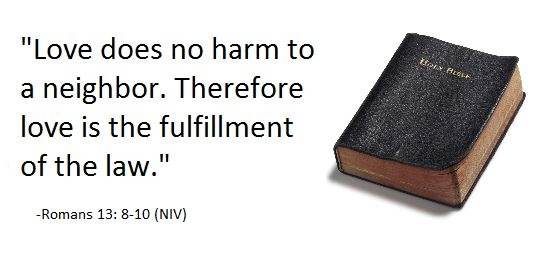
Love does no harm
What does it matter to us if the woman had been unfaithful? That's her burden to bear, her path to walk. No one is advocating for a life of sin followed by a get-out-of-jail-free card, but Jesus seems to be placing the emphasis on the importance of striving to be our best selves and extending mercy to everyone else. We each, in our own ways, are at times unfaithful to Christ and yet he loves us; he doesn't condemn us. "For God did not send his Son into the world to condemn the world, but in order that the world might be saved through him" (John 3:17 ESV). It is not our place to say what is or isn’t sin for someone else. Jesus is mighty to save, but ultimately that’s his job.

If Jesus himself declined to condemn an actual sinner caught “in the very act” (vs 4), then we certainly have no business making a point to express disapproval of anyone else’s life, homosexual or not. I’m pretty sure the only sin for which I will be held accountable is mine personally—whatever prevents me from being “at one” with God and my neighbor. He was pretty adamant that our greatest responsibility is just to love—love God and “love thy neighbor as thyself’ (Matthew 22: 35-40; Mark 12: 28-34).
Billboard
Does Jesus ever even mention to the woman what he personally thought about what she had done? He doesn’t have to—most likely she already knew what he believed. What’s most impressive is that he was more concerned with showing compassion to her, doing so both publicly and privately. Jesus then went on to teach that if we follow his example, we will not walk in darkness but have the light of life (John 8:12). Whatever that light-filled life means, it sounds like a much better way to live—for everyone involved.

It turns out that being about Jesus's and his Father's love business (and staying out of others business) is a really beautiful business to be in. Condemnation and judgement, on the other hand, are ugly—and a sin. Now, go and sin no more.

Wednesday, July 15, 2009

An Open Canon of Scripture: Gods Words Never Cease


"Some Christians, in large measure because of their genuine love for the Bible, have declared that there can be no more authorized scripture beyond the Bible. In thus pronouncing the canon of revelation closed, our friends in some other faiths shut the door on divine expression that we in The Church of Jesus Christ of Latter-day Saints hold dear: the Book of Mormon, the Doctrine and Covenants, the Pearl of Great Price, and the ongoing guidance received by God’s anointed prophets and apostles. Imputing no ill will to those who take such a position, nevertheless we respectfully but resolutely reject such an unscriptural characterization of true Christianity."

Elder Holland goes on to say that "the fact of the matter is that virtually every prophet of the Old and New Testament has added scripture to that received by his predecessors. If the Old Testament words of Moses were sufficient, as some could have mistakenly thought them to be, then why, for example, the subsequent prophecies of Isaiah or of Jeremiah, who follows him? To say nothing of Ezekiel and Daniel, of Joel, Amos, and all the rest. If one revelation to one prophet in one moment of time is sufficient for all time, what justifies these many others? What justifies them was made clear by Jehovah Himself when He said to Moses, “My works are without end, and . . . my words . . . never cease."

"One Protestant scholar has inquired tellingly into the erroneous doctrine of a closed canon. He writes: 'On what biblical or historical grounds has the inspiration of God been limited to the written documents that the church now calls its Bible? . . . If the Spirit inspired only the written documents of the first century, does that mean that the same Spirit does not speak today in the church about matters that are of significant concern?” We humbly ask those same questions."

"Continuing revelation does not demean or discredit existing revelation. The Old Testament does not lose its value in our eyes when we are introduced to the New Testament, and the New Testament is only enhanced when we read the Book of Mormon: Another Testament of Jesus Christ. In considering the additional scripture accepted by Latter-day Saints, we might ask: Were those early Christians who for decades had access only to the primitive Gospel of Mark (generally considered the first of the New Testament Gospels to be written)—were they offended to receive the more detailed accounts set forth later by Matthew and Luke, to say nothing of the unprecedented passages and revelatory emphasis offered later yet by John? Surely they must have rejoiced that ever more convincing evidence of the divinity of Christ kept coming. And so do we rejoice..."

"One other point needs to be made. Since it is clear that there were Christians long before there was a New Testament or even an accumulation of the sayings of Jesus, it cannot therefore be maintained that the Bible is what makes one a Christian. In the words of esteemed New Testament scholar N. T. Wright, “The risen Jesus, at the end of Matthew’s Gospel, does not say, ‘All authority in heaven and on earth is given to the books you are all going to write,’ but [rather] ‘All authority in heaven and on earth is given to me.’ “ In other words, “Scripture itself points . . . away from itself and to the fact that final and true authority belongs to God himself.” So the scriptures are not the ultimate source of knowledge for Latter-day Saints. They are manifestations of the ultimate source. The ultimate source of knowledge and authority for a Latter-day Saint is the living God. The communication of those gifts comes from God as living, vibrant, divine revelation."

-Elder Jeffrey R. Holland, “My Words . . . Never Cease”

Tuesday, April 21, 2009

Bart Ehrman: "Misquoting Jesus: Scribes Who Altered Scripture and Readers Who May Never Know"

A fascinating and educational presentation by Bart Ehrman, Distinguished Professor and Chair of the Department of Religious Studies at the University of North Carolina at Chapel Hill. Clearly, he's an intriguing New Testament scholar. He's also the author of the best selling book "Misquoting Jesus: The Story Behind Who Changed the Bible and Why". (Review at Dave's Mormon Inquiry here). This lecture was given at Stanford University, April 25th, 2007.

Part 1


Part 2


Part 3


Part 4


Part 5

Sunday, April 19, 2009

"Thou fool, that shall say: We have got a Bible, and we need no more Bible"

2nd Nephi 29:6 is usually interpreted to mean that there are some who will reject more of the Lord's words (ie: The Book of Mormon) because they're simply content with those which they currently have (ie: The Bible as we currently know it). Nevertheless, I'd like to suggest an alternate interpretation, just for the Latter-day Saints: We shouldn't ignore other versions of the Bible simply because we're content with the (King James) version we have.

Now, don't get me wrong. I'm not suggesting that the Church collectively should replace the King James Version as the authorized version. I'm merely wanting to share, from personal experience, that we can gain additional insight by incorporating another version into our personal study, along with the King James Version. Latter-day Saints have a great reverence for the Holy Bible, there's no doubt about that.


However, we don't really have much of a collective track record with other versions of the Bible aside from the KJV. True, there is the JST, but that's not really a "translation" in the conventional sense. It's more of an inspired commentary, some corrections, but mainly alternative ways of looking at verses that are quite correct. I hope that individually and collectively we continue to correct false ideas and tell the truth about the Holy Bible.

In the past year I've come across a couple of posts that have opened my eyes a bit. Perhaps others not quite as open minded to trying something new (or a more modern version) might find out that they do like green eggs and ham. Here was my food for thought:

Update the LDS Study Bible — Please!

Why the KJV?

After reading that first post I went out and bought a NIV (New International Version) bible and it’s been really enlightening. I’ve learned a lot–mostly from the additional resources it includes. But I found that I still actually enjoy reading the KJV better. I love the older language. It’s poetic, intellectually stimulating, and promotes thinking and revelation that I don’t get when it’s in common and ordinary English. So although I think we can be open to other translations of the Bible, I think I’m just personally biased with what I grew up with and I'll probably always prefer the KJV over the others.

I know that Elder Neal A. Maxwell read from at least the Revised Standard Version because I recently read a talk of his entitled “In Him All Things Hold Together” which is based off the text in Colosians 1:17 of the Revised Standard Version. The KJV says “by him all things consist”. Despite Elder Maxwell's example, there are probably still many LDS who are hesitant to pick up another version of the Bible. When I was younger, I think I was probably a little biased against other versions feeling that they were somehow less inspired. I’ve since come to know that great care was done to make the newer versions as perfect as possible based off the available Hebrew, Aramaic, and Greek texts. I'm convinced the Lord blessed their efforts.

It's now my standard practice to compare seeming obscure verses with those from another translation. There are even online sites that pull up multiple versions of the same verse side by side, which is truly a modern opportunity to enhance biblical scholarship. Again, I don’t feel we necessarily should or even ever will adopt another version of the Bible, but that shouldn’t keep us from expanding our horizons a bit. (Elder Maxwell did it).

Thursday, October 9, 2008

God is Three. God is One. And We Can Be One With God.


I've learned a lot from my blogging interactions with people not of our faith, as well as from my recent reading of "How Wide The Divide?" by Craig Blomberg (an Evangelical scholar) and Stephen Robinson (a Mormon scholar). One of the biggest things I realized, and it's simply huge, is that the Latter-day Saints are unique in their understanding that we are of the same essence or species of God. Evangelical Christians believe we are a different species from God, who "chose at some point to make creatures distinct from himself--human beings--with the capacity to have a personal realationship with him" (Blomberg).

Thus, Stephen Robinson writes: "The real sticking point is not what the LDS think of Christ and his gospel, but rather the different ontological frame or view of the nature of the universe into which Mormons fit the gospel. For Latter-day Saints also believe in the literal fatherhood of God and the brotherhood of humanity. We believe that God and humans are the same species of being and that all men and women were his spiritual offspring in a premortal existence. The main purpose of the gospel of Christ is therefore not so much to get us to heaven as it is to get us home."

If people don't understand this, then no wonder why we don't understand each other or we talk past each other. No wonder why other Christians would be confused that we believe we can become like God. For us, we are literally His children and therefore want to grow up to be like Him. We have the seeds of divinity in us. But for them, we'll always be different than God. Because Plato and Greek philosophy said that the "created" must always be separate from the "Creator", or the divine separate from the non-divine, the common thought that went into the councils and creeds was how to reconcile the fact that Christ was divine but also became a created man on earth.

We may believe in the same New Testament teachings of Jesus, but we definitely believe differently about the nature of God. I happen to like our understanding of God much more. :) I would find it hard to have faith in a mysterious and undefinable God that created "human beings" and put them on earth as if we're some kind of pet in a zoo or fish in a fish bowl, yet capable of having some kind of "relationship" with God--our owner or creator. I have faith in God and relate to Him and love Him as my Father in Heaven, who I lived with before I came to earth and wants me to return back to Him, but having grown from my experience here. So this is a fundamental difference, and I believe it's key to mutual understanding.

Incidentally, isn't it interesting that both "sides" can read the same bible and yet come away with such a different concept of God? Yet we each feel adamant that our interpretation is fully biblical. To quote Robinson again: "We believe in God, the Eternal Father, and in God's Son, Jesus Christ, and in the Holy Ghost. We accept the biblical doctrine that God is three and that God is also one, but we reject the post-New Testament attempts to explain how these two truths are to be reconciled."

It has been helpful for me to think of the "Trinity" (three persons in one being) as a solution to this "problem", that people saw that the scriptures talk of "one eternal God", and yet also that not only the Father was God, but Christ was God and fully divine, as well as the Holy Spirit. It seems that the Trinity was simply a solution for people who were afraid that worshipping three Gods, when the scriptures also clearly say that they are, or there is, "one God", would be polytheism. But Latter-day Saints also recognize the Father, Son, and Holy Ghost as one "God"--or the Godhead--without feeling there is a polytheism problem. Since all three of them are united as one in practically every way (except physically), we have no problem in thinking of them as "one eternal God" in three persons.

We even take it one step further and really believe that the Bible means what is says when Christ prays to His Father for his disciples, that "they all may be one; as thou, Father, art in me, and I in thee, that they also may be one in us" (John 17:21). What mercy and blessed grace indeed! Through the atonement of Christ, He will make us divine and change our natures so that we can be at one again with God, just as Christ is one with God. Yes, the word gospel means good news, and this is most definitely "good news"! What a testament to the power of the atonement of Jesus Christ!

Wednesday, October 1, 2008

A Different Jesus?


I made a post about this stinging question some time ago (Worshiping Jesus differently does not equal "a different Jesus") but I like the way Stephen Robinson puts it much better:

"Evangelicals often accuse Latter-day Saints of worshipping a 'different Jesus' because we believe some things about Jesus that cannot be proven from the Bible. However, I would point out that John thought Jesus was crucified the afternoon before Passover (John 19:14; 18:28), so that the Last Supper was not the Passover meal, while Matthew, Mark and Luke say Jesus ate the Passover with the disciples and was crucified the morning after (Mark 14:12, Matthew 26:17-19; Luke 22:13-15). Is John (or the Synoptics) writing about a 'different Jesus,' or do they simply disagree on the details concerning one Jesus?

If some Christians think Jesus had siblings and other Christians think that he did not, or if some think he stayed in Egypt for years while others think it was merely for weeks or months, do they worship different beings? If I think Jesus liked his veggies and you think he didn't, are we therefore talking about two different people? Some Evangelicals, like the Mormons, do not accept the Nicene and Chalcedonian definitions, I am told, but limit their Christology to the New Testament data. Do these people also worship 'a different Jesus' than other more creedal Evangelicals, and are they therefore not Christian?

This charge, that people worship 'a different Jesus' if they disagree over any detail of his character or history, is simply a rhetorical device, a trick of language. All I can say to it is that Latter-day Saints worship that divine Son of God of whom the apostles and prophets of the Old and New Testaments bear record, and we believe all that they have to say about him. There is no biblical information about the Son of God that the Latter-day Saints do not affirm. If Evangelicals truly worship 'a different Jesus' than this, I shall be greatly disappointed." (Stephen E. Robinson, "How Wide The Divide?")

Sunday, June 1, 2008

Are you telling the truth about the Bible?


Someone not of our faith recently asked me a question I was glad to answer. He was under the impression that LDS people believe the Bible had been corrupted and wanted to know "just exactly how the Bible has been corrupted". I appreciated him for asking the question and for having the chance to respond.

My response is based off of my New Testament class notes with Stephen Robinson while I studied at BYU several years ago. He was a master teacher and his areas of expertise were Biblical Studies (New Testament, Christian Origins, History of Christianity), as well as LDS studies. He reads Greek, Hebrew, Syriac, Aramaic, and Coptic—so he’s done his homework. Based off that class I learned some things about the Bible I didn’t know previously—some of which I used to try to answer the question and clear up any misunderstanding.

Our present New Testament dates back to about 367 A.D. when the books of scripture were organized. Sometime between 50 A.D. and 100/175 A.D. some “plain and precious” things were taken out. They were NOT edited or altered (corrupted?). They were just lost. Comparing the books of scripture to a file cabinet—some files were just taken out and lost completely. They weren’t edited—just lost. (For example, 1st Corinthians 5:9—that epistle was lost. Try to picture a letter to Loudicious, or a letter .5 to the Corinthians, versus the first letter that we know of.)

Now, in the copying of the copies of the biblical manuscripts, accidental scribal mistakes were made--that's just historical fact. Also, according to Dr. Bart Ehrman, "scribes occasionally altered the words of their sacred texts to make them more patently orthodox and to prevent their misuse by Christians who espoused aberrant views." Most of these alterations were relatively minor and did not affect fundamental Christian doctrine.

We ought to be thankful the monks preserved that which we have. That which we have (our present Bible) is largely correct—and apostolic. We testify of the miracle of the Holy Bible.


The second century church Hellanized the Bible. (They tried to make it fit into Greek theory). Now there are over 5,000 manuscripts of the New Testament. No two are alike. And there is no such thing as “the original Greek”, only scholarly reconstructions of what we think Paul must have written.

Jesus probably spoke Aramaic, and Greek as a second language. (One side note that I find interesting is that the word always translated “carpenter” in Greek means “architect, builder, contractor”. The Greek “Tekton” means builder. Thus, the “Builder” of the Universe was a builder by profession. (Jesus would have worked in wood and stone).

But the Bible as we know it today is largely correct. The truer LDS understanding is that there were completely lost books--like a file was just deleted from the computer and never was included in the Bible that we have today. Now certainly there are a few things that got changed up in the translations and in the copying of the original scripts, but the truth is we can’t know for sure how much or how many. So I thank God that we have what we have in the Holy Bible--I love the Bible--as well as the further “plain and precious” things contained in the Book of Mormon.

Wednesday, January 23, 2008

The Old Testament made new again! (at least to me)


I never would have guessed the enjoyment and relevance I'm finding in the Old Testament! Before I started teaching seminary a few weeks ago, deep down I think I believed that people who would say that the Old Testament still applies to our lives were having to stretch the truth just a bit--like those CES types that have to say that because it's their job. You know how it is, you politely agree but inside you're kind of rolling your eyes. Boy am I glad to say I have been pleasantly surprised by how wrong I was. It would take too much time to blog all of the the treasures I'm finding in what's suddenly becoming a very new and fresh Old Testament-at least to me. And it's really quite a joy to share in this experience with my ward seminary class, despite the fact that it does wear on me to constantly be waking up so early and always in "crunch-time" mode to be prepared for a great class. It's still a joy because its effects are longer lasting and more rewarding.

My first thought when I found out I would be teaching the Old Testament in seminary was "oh great" in a sarcastic kind of way. My experience with the book has not been plentiful, and it also has not been memorable. I never took an Old Testament class at BYU, and I certainly don't remember anything from my high school seminary years. I think we went through 3 or 4 teachers, and I can only remember the name of one of them. So it's exciting to think that I can help give the kids an experience that I never had. And when I read the Old Testament on my mission, I was mostly looking for "one-liners" here and there (or famous scriptures) that I felt gave me instruction of how to better follow the Lord, praise the Lord, and live closer to him. I certainly didn't see how everything fit together. I knew how much the restoration scriptures add to our understanding of the Old Testament--but somehow those pages still stayed a little bit newer than all the other pages in my quadruple combination.

Now I'm being forced to really study it inside and out. In a selfish kind of way, I'm glad because my understanding is deepening. After all, the blessings promised in D&C 88:78 were directed towards the TEACHER. "Teach ye diligently and my grace shall attend YOU, that YOU may be instructed more perfectly in theory, in principle, in doctrine, in the law of the gospel, in all things that pertain unto the kingdom of God, that are expedient for YOU to understand." I think that's a good kind of selfishness! Look at what I get out of it if I simply "teach diligently"! I can sure use a bit more grace and "more perfect" instruction. Thanks also to the seminary and institute manuals that help explain things to me that I otherwise wouldn't have recognized by simply reading on my own. Now I get to better explain things to my students and show them how timeless some of these lessons are, and how the experiences of the people that lived so long ago still apply to our lives here and now. They're fewer and farther in between than in the New Testament and the Restoration scriptures, but they're there! And I also get to enjoy some really weird eyebrow raising stories mixed in. What more could I ask for?
I enjoy finding the humor and interesting ironies as well as the spiritual enrichment--it makes it more "real" to me-just like life itself. I don't know it as well as I know my other scriptures, but it's becoming a lot more familiar. And somehow it's like the Old Testament is becoming new all over again.

Tuesday, January 15, 2008

Seminary

I just have to say how much I enjoy teaching seminary. There are some really sweet moments and I love the Spirit that is there, especially when the students participate. I teach a great class of juniors and seniors-9 or 10 of them. They're a welcome change from 8th graders the rest of the day. I'm fully aware that I'm not the real teacher--the Spirit is, and I simply hope to create an enviornment that invites the Spirit and edifies with some lasting lessons from the Old Testament. I thought the hardest part of this seminary "assignment" would be waking up at 5am, but that's the easy part. The "hard" part is the responsibility weighing on me each night to be prepared and ready for a great 50 minute lesson early the next morning. But even that is an enjoyable experience, at least when I make enough time for preparation, family, and for sleep! There's no doubt about the power of the word, the power of the Word, and of the "work"--imperfections and all.