Friday, July 4, 2014

Shifting Faith Paradigms of a Mormon Academic


If you know me well, or perhaps if you read about my own shifting faith paradigms/personal faith journey, you might understand why I feel a kinship to Armand Mauss after reading the following excerpts. They come from the beginning and the end of chapter 3 in Mauss's memoir: "Shifting Borders and a Tattered Passport: Intellectual Journeys of a Mormon Academic". Buy the book–seriously! By way of introduction, I'll quote Richard Bushman from the forward:


As with all intellectuals, Mauss had his private battles to fight as well. His greatest early struggle was with "the social construction of reality," the notion that was sweeping the scholarly world at the time of his intellectual formation in graduate school. The words "social construction" mean that each society puts together it's own version of reality rather than finding a fixed and unchangeable reality out there somewhere. Independent reality may exist with God, and be known by faith, but humans have no direct access to it via reason and science. Every truth we know comes through a human mind embedded in a society of some kind. We have to accept the principle that every conception of reality is contingent on the conditions in the society where that conception originates. One can imagine the impact of this realization on a young Mormon scholar who had been raised on belief in absolute truth. One of the most intriguing passages in the memoir is the account of how Mauss coped with this crisis.


With five years' bishopric service behind me, I ventured back into the secular academic world to resume my graduate studies in 1962. I was, of course, expecting to be exposed to new intellectual territory, especially since I was switching my disciplinary focus from history to sociology for the doctorate. I did not, however, expect to be confronted with an entirely new ontology and epistemology. As my intellectual development continued, the sociological concept that truth or reality is socially constructed turned out to offer a greater challenge to my religious faith than anything else I was to encounter in my entire academic career. Gradually came to terms with that challenge, however, and eventually became quite comfortable with the "social constructionist" way of understanding reality.

My upbringing as a Mormon, as well as my intellectual training under the Jesuits at Sophia University, had equipped me with an absolutist or essentialist ontology. I recognized, of course, that there could be a variety of understandings and interpretations of reality derived from different cultures, religions, and life circumstances. Yet, among all of these, or perhaps outside of them, there would be a single ontology – an absolute reality as defined by God or as given in nature or both. The search for truth was a matter of applying the empiricism, the logic, and the epistemology, well known since the ancient Greeks, to get beyond all these differing conceptions to the real truth, or the true reality, in the universe. I have observed that most people, at least in the Euro–American world, grow up with similar epistemological and ontological assumptions and rarely have reason to question them.

I am not sure exactly when my doubts about these assumptions began, but it was sometime after I returned to sustained doctoral study in sociology in the 1960s. I recall no sudden epiphany or "breakthrough," no sense that I was leaving behind one entire intellectual paradigm for a different one. My intellectual transitions always seem to have been gradual and evolutionary. I simply became increasingly aware of the need to reconsider and revise earlier assumptions in light of new ideas to which I had been exposed...

[Different works and readings eventually helped show] how different visions of reality emerge from different social circumstances and...these works made clear the processes by which different cultures and interest groups construct the ideas, facts, "plausibility structures" that come to be "taken for granted" by their respective members – a process defined as the "sociology of knowledge" in academia. The major implication here is that any notion of "absolute" truth or reality, of the kind promulgated by the Judeo-Christian traditions, might ultimately exist in the mind of God, or in some other great cosmological sense, but if so, we as human beings have no access to it through any field of science.

Therefore, if we embrace any reality as "objective," existing independently of human invention, of the kind claimed in religions like Catholicism or Mormonism, then we do so on faith, as a matter of choice. Operationally speaking, the only reality we "know" is that which has been constructed by our families and passed along to us as part of our cultural heritage. In this way of looking at reality, it is easy to see how different claims to truth are embraced as ontological realities, not only in religion but also in science, in politics, and in many other fields of human knowledge. Where religion was concerned, at least in my case, it became increasingly obvious that if I were to continue as an active believer in the LDS faith, it would be mainly a matter of choosing to embrace a certain construction of reality, not the result of a meticulous process of testing and proving incontrovertible claims about the supernatural...

My reflections on this predicament [that embracing a social constructionist epistemology (that reality or truth is socially constructed within each contending society) is more relativistic than and challenges the traditional Christian and Mormon absolutist conceptions of reality/epistemology], however, led me not away from faith but rather toward a realization that in order to engage in a community of discourse, whether ethnic, religious, political, or any other kind, I would first have to understand that community's epistemology and ontology. My understanding, then, would depend on interpreting its discourse and behavior through the lens of its own shared conceptions of reality, rather than through my own or other lenses that I might bring to the examination. The same would be true, of course, for understanding the discourse and behavior in my own religious community. I had already learned to understand LDS reality as an insider and had taken that for granted. My new understanding, however, did not require me to abandon my religious community, ontology, or epistemology, but only to embrace them as a matter of choice, rather than as the only valid way of seeing reality.

Such a recognition seemed to accord also with a theological conception of faith as an active personal choice, rather than as a passive acceptance of a religious tradition. A social constructionist understanding of reality, furthermore, leaves one free also to reject any secular definition as the only true understanding of reality, since no particular epistemology can claim privileged status in the eyes of God or nature–or (still less) in Academia. Any epistemology has validity only within its own community of discourse. My "Mormon passport," then, was as valid as any other as I traveled through the various communities of discourse that I encountered. This line of reasoning, one might say, further relativizes the relativity of the social scientist's construction of reality. The scholar thus remains free to embrace the epistemology and ontology of a religious believer for ordering his or her own life and world, while at the same time being entirely free to venture into other epistemological worlds to understand other peoples with their respective discourse and behavior.


Wednesday, July 2, 2014

"Renegade Acts of Radical Acceptance"

Lon Young is a former colleague of mine, but more importantly he has become dear friend. He began five years of service as a Mormon bishop in Utah right around the time my family and I moved to Texas. I'm grateful he started a blog because he's a very gifted writer with a giant and inclusive heart. When he has shared his thoughts, whether with me personally or publicly, I often find myself surprised at how like-minded we are, and I have been moved by his words on many occasions. Unlike him, however, I have no plans to move my family to India for a year to volunteer in a leprosy colony. The following words are excerpted from his post "Circles of Inclusion: A letter to my community from the leprosy colonies."

It was not the gods who did this–they did not command us to kick each other out of the church; they did not whisper that TRUTH was such a fragile thing it needed protection from IDEAS; they did not inspire us to pick up stones and hurl them at one another; they surely did not teach us that moral influence and power should be maintained by virtue of priesthood office, nor by exercising control, dominion, or compulsion, nor by contracting out the dirty work to modern-day hirelings, the PR Department.

Sadly, it seems to me that the hand of inclusion and acceptance we’d been extended by a few apostolic leaders seems to have been withdrawn. Now it’s all jabs and sucker-punches.

BUT I ALSO HEAR REPORTS OF KINDNESS, of inclusion, of individual ministries where institutional ones have failed. I rally when I hear these reports. They tell me that pockets of fresh air are possible where two or more are truly gathered in His name–a kind of rescue breathing where words of acceptance and inclusion resuscitate the dead and dying.

To those who have been excommunicated from the body of believers, whether formally (institutional punishment) or informally (social punishment), my heart aches for you. I’ve been working among the leprosy-affected here in India enough to witness how dehumanizing it is to be shunned, marginalized, even banished from a community. I’ve also come to understand the fear and ignorance lurking under the surface of such behavior. But you are not unclean for questioning injustice. You are not filthy for calling foul. You are not untouchable for challenging the status quo.

Every time someone, in fear, draws a circle that excludes you from the Mormon community, please know there are others of us drawing circles wide enough to take you in. And as your brothers and sisters, we will continue our commitment to inclusion, through renegade acts of radical acceptance, until we find ourselves—all of us–circumscribed into one great whole.


http://buddhainthebeehive.wordpress.com/2014/07/02/circles-of-inclusion-a-letter-to-my-community-from-the-leprosy-colonies/

Monday, June 30, 2014

Epistemological humility about "the same organization that existed in the primitive church"

Armand Mauss on a humbling mission experience (from "Shifting Borders and a Tattered Passport: Intellectual Journey's of a Mormon Academic", pages 8-9):

Among my most important [missionary] experiences in that town [Torrington, Connecticut] was an encounter with a Protestant minister. (Episcopal vicar, as I recall, though he might have been congregational – my memory is not clear on this). Over the resistance of my senior companion, we called at the parsonage or rectory, as the residence was usually called, and we were greeted by a dignified clergyman who reluctantly invited us in. What followed, at least from my viewpoint, was a debacle that had a profound impact on my faith, to say nothing of my ego. The vicar dealt with us kindly. He recognized and seemed to value our sincerity and intellectual naïveté as he listened patiently to my recitation of the conventional Latter-day Saint understanding of the organization of the primitive Christian church, complete with proof-text verses from the New Testament. 
When I had finished, he said he had a few questions, which raised my hopes until I realized that his "questions" all had to do with such matters as the historical sources on which I had based my presentation, my understanding of the various functions of ecclesiastical roles within the primitive church, and my grasp of the meaning of certain terms in ancient Greek (starting with ecclesia.) Then came a thirty-minute tutorial on the historical and linguistic difficulties of figuring out how closely the organization and functions of the primitive Christian church resembled any modern model, LDS or otherwise. I was stunned and humbled. I had had no idea that so much knowledge was available outside of LDS literature on subjects of such great importance to the LDS religion itself. That entire experience left me with two resolutions that have guided my intellectual explorations ever since: I would never again enter controversy so ill-equipped to defend my own convictions, and I would never again consider one interpretation of the scriptures – by my religion or any other – as the only authoritative word on anything. The first resolution meant that I would spend as much of my free time as possible in local libraries during my mission, and with the second resolution, I was fated, from that point on, to live in a certain intellectual tension with the conventional understandings of some of my fellow Mormons and our leaders.

Tuesday, June 24, 2014

"Scholars seem stubborn and proud, whereas laypeople seem complacentand unaware."

"During parts of Mauss's life, LDS intellectuals did not always enjoy an entirely comfortable place in the church. Devoted as he was, he was sometimes summoned by leaders to account for some of his scholarly publications on Mormon matters. Church leaders, not familiar with the ways of intellectuals and a little skeptical, did not immediately recognize these publications' potential usefulness. The hardest thing for ordinary Mormons to appreciate is the battle intellectuals are called upon to fight to make sense of the world. Their very effectiveness as intellectuals grows out of their commitment to ideas and evidence. Whereas most people want simple, clear conclusions in harmony with their own preconceptions, scholars have to deal with the evidence and hammer out ideas. The advice to "forget it" when they come across a troubling idea is precisely what they cannot do. Their work would be useless if they did not make these pains. Inevitably, there will be misunderstandings. Scholars seem stubborn and proud, whereas laypeople seem complacent and unaware. Even when both parties act with goodwill, it takes time to achieve mutual understanding."

From Richard Bushman's foreword of Armand L. Mauss's memoir: "Shifting Borders and a Tattered Passport: Intellectual Journeys of a Mormon Academic".

Thursday, June 19, 2014

We've Polluted the Holy Church of God

I personally have not agreed with every move Kate Kelly or Ordain Women have made. I worry that pride is overriding her humility, and thus her effectiveness for being an agent for good. But I see some of that in myself, so I sympathize. (I should also probably add that I've also been disappointed with much of the way church officials have handled this whole ordeal, as well.)

Mostly, I listen and try to understand rather than rush to judgement. I admit, it sometimes comes easier for me to do this to the side of the underdog, but I know that I need to extend compassion in all directions.

In Mormon 8, Moroni says he speaks to us as if we're present. Then he proceeds to tell us that we've polluted the holy church of God. The worst form of pollution I see is how "Christlike" members have treated each other over faithful differences and points of concern. There has been too much of shunning, judgment, and accusations, and not enough listening, understanding, compassion, and love.


If President Monson or other church leaders have been hurt by anything that has gone down, this is what I think has hurt more than anything--not the existence of Ordain Women, but the despicable responses to OW from fellow Saints. We've polluted the holy church of God. The fruit is seen in the way Kate Kelly's "court of love" is being handled and discussed.

Of course, I'm not sure how aware President Monson is aware of the details since it has been confirmed by top leadership (though not publicized) that he suffers from "short term memory loss", or dementia.

So we need prayers for EVERYONE involved.

Monday, June 16, 2014

Room for All in this Church


Room for All in this Church

We face a difficult and pivotal moment in Mormonism as LDS leaders and church members wrestle more openly with complicated aspects of our faith, its doctrine, and its history—often in spaces afforded by the Internet. In light of possible disciplinary action against prominent voices among us, we the undersigned Mormon bloggers and podcasters affirm the value of the conversations that take place in the LDS “Bloggernacle” and express our hopes for greater understanding and compassion from all of us involved in current tensions.

May we all remember, as scripture teaches, the intricate intertwining of mercy and justice. May we all follow the admonition to seek understanding before judgment, even as we address matters that can be difficult to talk about.

Scripture and tradition teach us that excommunication is one way of maintaining the boundaries of a religious community. But we believe that excommunication is not the best way to address conflict over doctrine, policy, or tradition. We ask our leaders to consider other ways of maintaining boundaries, strengthening Church members, and encouraging them to grow spiritually within Mormonism’s large and embracing community without the fear and despair the threat of excommunication sows not only in those threatened but in their families, friends, and those who share similar concerns about LDS Church doctrine or history—even those who do so silently. We are deeply encouraged by the recent news about the prospect of de-escalation in at least one of the current cases and pray for positive steps towards reconciliation.

The issues in Mormon doctrine, history, and practice highlighted by those facing church discipline are much larger than any one individual. It is not only unavoidable that these issues will continue to be discussed; such discussion is good for the health of our religious community and faithful to the truth-seeking spirit of the Latter-day Saint Restoration. As bloggers, podcasters, and passionate contributors to good, healthy online discussion, we affirm our commitment to continue speaking openly and publicly, and encouraging others to do so as well. We will continue to use online spaces to grow in knowledge and faith, to attempt to present and see many sides of each issue, and to reach out to those expressing pain, heartache, and loneliness. It is our experience that these conversations can bear good fruit as Latter-day Saints mourn with those who mourn and reflect on, deepen, and renew their faith.

We are grateful for our membership in this Church and for the unique opportunities the Internet has provided us to share our Mormon experiences, questions, and hopes. We pray that a spirit of clemency will guide the words and actions of everyone—especially those who bear the heavy responsibility of ecclesiastical discipline of Church members—and that the words of President Uchtdorf will hold sway: “Regardless of your circumstances, your personal history, or the strength of your testimony, there is room for you in this Church.”

Signed:

Dan Wotherspoon, Mormon Matters podcast
Jana Riess, Flunking Sainthood blog (Religion News Service)
Natasha Helfer Parker, The Mormon Therapist blog
Paul Barker, Rational Faiths blog and podcast
Michael Barker, Rational Faiths blog and podcast
Mark Crego, A Thoughtful Faith Support Group (Facebook)
Lisa Butterworth, Feminist Mormon Housewives
Joanna Brooks, Feminist Mormon Housewives
Gina Colvin, KiwiMormon blog
Lindsay Park, Feminist Mormon Housewives
Jared Anderson, Mormon Sunday School podcast
Daniel Parkinson, No More Strangers blog
Bill McGee, Sunstone
Mary Ellen Robertson, Sunstone
Stephen Carter, Sunstone
Michael Stevens, Sunstone
Chelsea Shields Strayer, LDS WAVE
Tresa Edmunds, LDS WAVE
Chelsea Robarge Fife, Mormon Feminist Cooperative
Cami Ashby, Feminist Mormon Housewives
Kalani Tonga Tukaufu, Feminist Mormon Housewives
David Landrith, Mormon Mentality
Jennifer Finlayson-Fife, Mormon Matters podcast
Jerilyn Hassell Pool, Rational Faiths blog
Spencer Lake, Clean Cut blog
Brittany Morin-Mezzadri, TheLadyMo blog
Katie Langston, Feminist Mormon Housewives blog
Hannah Wheelwright, Young Mormon Feminists blog
Erin Moore, Young Mormon Feminists blog
Kimberly Lewis, Feminist Mormon Housewives
Nikki Hunter, Feminist Mormon Housewives
Nancy Ross, Nickel on the ‘Nacle blog
Mark Brown, The Mormon Hub (Facebook)
Alicia Jones, LDS Left (Facebook)
Elise Villescaz, LDS Left (Facebook)
Emily Summerhays, Feminist Mormon Housewives
Mindy Farmer, The Inquisitive Mom blog
Jeff Krey, A Thoughtful Faith Support Group (Facebook)
Lori Burkman, Rational Faiths blog
Laura Compton, Mormons for Marriage
Alison Moore Smith, Mormon Momma blog
Heather Olsen Beal, Doves and Serpents blog
Brent Beal, Doves and Serpents blog
Ed Snow, Doves and Serpents blog
Erin Hill, Doves and Serpents blog
Meghan Raynes, Exponent blog
Aimee Hickman, Exponent blog
Rachel Hunt, Exponent blog
Liz Johnson, Exponent blog
Libby Potter Boss, Exponent blog
Heather Moore-Farley, Exponent blog
April Young Bennett, Exponent blog
Deborah Farmer Kris, Exponent blog
Jessica Oberan Steed, Exponent blog
Carolyn Kline, Exponent blog
April Carlson, Exponent blog
Sariah Anne Kell, Exponent blog
Chelsea Sue, Exponent blog
Emily Clyde Curtis, Exponent blog
Emily Updegraff, Exponent blog
Dayna Patterson, Doves and Serpents blog
Cheryl Bruno, Worlds Without End blog
Katie Evans, Zelophehad’s Daughters blog
Kristy Benton, All Are Alike Unto God blog
Lori LeVar Pierce, All Are Alike Unto God blog
Rebecca Reid Linford, All Are Alike Unto God blog
Paula Goodfellow, All Are Alike Unto God blog
Cheryl McGuire, All Are Alike Unto God blog
Kay Gaisford, All Are Alike Unto God blog
Lorlalie Pallotta, All Are Alike Unto God blog
Wendy Reynolds, All Are Alike Unto God blog

Sunday, June 15, 2014

"If we have the truth, it cannot be harmed by investigation. If we have not the truth, it ought to be harmed."

"If we have the truth, it cannot be harmed by investigation. If we have not the truth, it ought to be harmed."
-J. Reuben Clark

I'm baffled that some dismiss any effort to ask hard questions in an honest attempt to find out what "the truth" is. In a church that only requires us to believe "truth", why is the default setting to view such attempts that dig deep to find out what the truth is as though it is all "negativity" and a threat?

If one uses a jackhammer to try and separate fact/truth/ideal from the concrete of reality, tradition, and even current teachings assumed to be truth, we should be thankful for such work, not marginalize the worker because of the temporary noise.

Friday, June 13, 2014

The church is made up entirely of human beings

Last weekend at the Mormon History Association conference held here in San Antonio I met Philip Barlow, the Harvard-educated Arrington Chair of Mormon History and Culture at Utah State University. I spoke with him about an insight he has shared that I personally find quite helpful and asked him to record his own voice dictating it into my iPhone. I just transcribed it:

"I think faith is misconstrued when we think of the church as essentially divine marred only by a few freckles or difficulties, but rather is better conceived of as made up entirely of human beings (with everything that implies, and it implies a great deal). The church is made up entirely of human beings from top to bottom and from Joseph Smith on, who are trying to respond to the divine with which they've been touched in faith."


Wednesday, June 11, 2014

Kate Kelly is No Apostate. She is Us.

There is a great story from pages 55-56 in “David O. McKay and the Rise of Modern Mormonism” in which Joseph Fielding Smith and Harold B. Lee were moving to excommunicate Sterling McMurrin for his unorthodox beliefs. When President David O. McKay heard about it, he phoned McMurrin and asked for a private meeting. In that meeting, McKay was never critical nor disapproving. He told McMurrin: “They cannot do this to you! They cannot put you on trial!” and that if they did, he (the President of the Church) would be McMurrin’s “first witness”.

McMurrin said: “I should have been censured for being such a heretic, and here President McKay wasn’t even interested in raising a single question about my beliefs, but simply insisted that a man in this Church had a right to believe as he pleased. And he stressed that in several ways… It was really a quite remarkable experience, to have the President of the Church talking in such genuinely liberal terms.”

I love that story. It makes me really love and respect President McKay. Would that we could have more Saints like him today. Especially because Kate Kelly is no apostate nor even close to the heretic Sterling McMurrin was. She is a good and faithful women who has the audacity to suggest a prophet can seek answers to some very good questions. She may ruffle some feathers, but I understand that Jesus himself ruffled quite a few feathers. And I think Jesus would be very sad today. And mad at the religious establishment, as he so often was.

http://ordainwomen.org/excommunication/

I'm going to hold out some hope that my church will have learned it's lesson from the debacle of the September 6 in 1993. I'm convinced that nobody wants to find out what this current debacle is going to look like in the current age of the Internet.

Thursday, June 5, 2014

Owning Our History: Race and the Priesthood

This Sunday, June 8th, marks the anniversary of a significant and historic turning point in the ongoing saga of the Restoration. On the corresponding occasion five years ago, I publicly declared on this blog "Why I Don't Believe That God Instituted The Priesthood Ban." For me, it was a bold move. Traditional interpretations had long been ingrained into the collective Mormon psyche.

Late last year the Church published an online essay entitled "Race and the Priesthood." It too was a significant turning point in the ongoing Mormon saga of portraying Church history more honestly, candidly, and thoroughly. It doesn't necessarily connect all the dots for the reader, but the reader can gain important perspectives. Hindsight tends to give a lot clearer picture than the murkiness of "the present".

To commemorate the June 8th occasion this year, I simply want to spotlight again the excellent talk by Jonathan Stapley "Commemorating the Revelation", as well as repost the latest online Church essay below:


Race and the Priesthood


In theology and practice, The Church of Jesus Christ of Latter-day Saints embraces the universal human family. Latter-day Saint scripture and teachings affirm that God loves all of His children and makes salvation available to all. God created the many diverse races and ethnicities and esteems them all equally. As the Book of Mormon puts it, “all are alike unto God.”1
The structure and organization of the Church encourage racial integration. Latter-day Saints attend Church services according to the geographical boundaries of their local ward, or congregation.  By definition, this means that the racial, economic, and demographic composition of Mormon congregations generally mirrors that of the wider local community.2  The Church’s lay ministry also tends to facilitate integration: a black bishop may preside over a mostly white congregation; a Hispanic woman may be paired with an Asian woman to visit the homes of a racially diverse membership. Church members of different races and ethnicities regularly minister in one another’s homes and serve alongside one another as teachers, as youth leaders, and in myriad other assignments in their local congregations. Such practices make The Church of Jesus Christ of Latter-day Saints a thoroughly integrated faith.
Despite this modern reality, for much of its history—from the mid-1800s until 1978—the Church did not ordain men of black African descent to its priesthood or allow black men or women to participate in temple endowment or sealing ordinances.
The Church was established in 1830, during an era of great racial division in the United States. At the time, many people of African descent lived in slavery, and racial distinctions and prejudice were not just common but customary among white Americans. Those realities, though unfamiliar and disturbing today, influenced all aspects of people’s lives, including their religion. Many Christian churches of that era, for instance, were segregated along racial lines. From the beginnings of the Church, people of every race and ethnicity could be baptized and received as members. Toward the end of his life, Church founder Joseph Smith openly opposed slavery. There has never been a Churchwide policy of segregated congregations.3
During the first two decades of the Church’s existence, a few black men were ordained to the priesthood. One of these men, Elijah Abel, also participated in temple ceremonies in Kirtland, Ohio, and was later baptized as proxy for deceased relatives in Nauvoo, Illinois. There is no evidence that any black men were denied the priesthood during Joseph Smith’s lifetime.
In 1852, President Brigham Young publicly announced that men of black African descent could no longer be ordained to the priesthood, though thereafter blacks continued to join the Church through baptism and receiving the gift of the Holy Ghost. Following the death of Brigham Young, subsequent Church presidents restricted blacks from receiving the temple endowment or being married in the temple. Over time, Church leaders and members advanced many theories to explain the priesthood and temple restrictions. None of these explanations is accepted today as the official doctrine of the Church.

The Church in an American Racial Culture

The Church of Jesus Christ of Latter-day Saints was restored amidst a highly contentious racial culture in which whites were afforded great privilege. In 1790, the U.S. Congress limited citizenship to “free white person[s].”4 Over the next half century, issues of race divided the country—while slave labor was legal in the more agrarian South, it was eventually banned in the more urbanized North. Even so, racial discrimination was widespread in the North as well as the South, and many states implemented laws banning interracial marriage.5 In 1857, the U.S. Supreme Court declared that blacks possessed “no rights which the white man was bound to respect.”6 A generation after the Civil War (1861–65) led to the end of slavery in the United States, the U.S. Supreme Court ruled that “separate but equal” facilities for blacks and whites were constitutional, a decision that legalized a host of public color barriers until the Court reversed itself in 1954.7
In 1850, the U.S. Congress created Utah Territory, and the U.S. president appointed Brigham Young to the position of territorial governor. Southerners who had converted to the Church and migrated to Utah with their slaves raised the question of slavery’s legal status in the territory. In two speeches delivered before the Utah territorial legislature in January and February 1852, Brigham Young announced a policy restricting men of black African descent from priesthood ordination. At the same time, President Young said that at some future day, black Church members would “have [all] the privilege and more” enjoyed by other members.8
The justifications for this restriction echoed the widespread ideas about racial inferiority that had been used to argue for the legalization of black “servitude” in the Territory of Utah.9 According to one view, which had been promulgated in the United States from at least the 1730s, blacks descended from the same lineage as the biblical Cain, who slew his brother Abel.10 Those who accepted this view believed that God’s “curse” on Cain was the mark of a dark skin. Black servitude was sometimes viewed as a second curse placed upon Noah’s grandson Canaan as a result of Ham’s indiscretion toward his father.11 Although slavery was not a significant factor in Utah’s economy and was soon abolished, the restriction on priesthood ordinations remained.

Removing the Restriction

Even after 1852, at least two black Mormons continued to hold the priesthood. When one of these men, Elijah Abel, petitioned to receive his temple endowment in 1879, his request was denied. Jane Manning James, a faithful black member who crossed the plains and lived in Salt Lake City until her death in 1908, similarly asked to enter the temple; she was allowed to perform baptisms for the dead for her ancestors but was not allowed to participate in other ordinances.12 The curse of Cain was often put forward as justification for the priesthood and temple restrictions. Around the turn of the century, another explanation gained currency: blacks were said to have been less than fully valiant in the premortal battle against Lucifer and, as a consequence, were restricted from priesthood and temple blessings.13
By the late 1940s and 1950s, racial integration was becoming more common in American life. Church President David O. McKay emphasized that the restriction extended only to men of black African descent. The Church had always allowed Pacific Islanders to hold the priesthood, and President McKay clarified that black Fijians and Australian Aborigines could also be ordained to the priesthood and instituted missionary work among them. In South Africa, President McKay reversed a prior policy that required prospective priesthood holders to trace their lineage out of Africa.14
Nevertheless, given the long history of withholding the priesthood from men of black African descent, Church leaders believed that a revelation from God was needed to alter the policy, and they made ongoing efforts to understand what should be done. After praying for guidance, President McKay did not feel impressed to lift the ban.15
As the Church grew worldwide, its overarching mission to “go ye therefore, and teach all nations”16 seemed increasingly incompatible with the priesthood and temple restrictions. The Book of Mormon declared that the gospel message of salvation should go forth to “every nation, kindred, tongue, and people.”17 While there were no limits on whom the Lord invited to “partake of his goodness” through baptism,18 the priesthood and temple restrictions created significant barriers, a point made increasingly evident as the Church spread in international locations with diverse and mixed racial heritages.
Brazil in particular presented many challenges. Unlike the United States and South Africa where legal and de facto racism led to deeply segregated societies, Brazil prided itself on its open, integrated, and mixed racial heritage. In 1975, the Church announced that a temple would be built in São Paulo, Brazil. As the temple construction proceeded, Church authorities encountered faithful black and mixed-ancestry Mormons who had contributed financially and in other ways to the building of the São Paulo temple, a sanctuary they realized they would not be allowed to enter once it was completed. Their sacrifices, as well as the conversions of thousands of Nigerians and Ghanaians in the 1960s and early 1970s, moved Church leaders.19
Church leaders pondered promises made by prophets such as Brigham Young that black members would one day receive priesthood and temple blessings. In June 1978, after “spending many hours in the Upper Room of the [Salt Lake] Temple supplicating the Lord for divine guidance,” Church President Spencer W. Kimball, his counselors in the First Presidency, and members of the Quorum of the Twelve Apostles received a revelation. “He has heard our prayers, and by revelation has confirmed that the long-promised day has come,” the First Presidency announced on June 8. The First Presidency stated that they were “aware of the promises made by the prophets and presidents of the Church who have preceded us” that “all of our brethren who are worthy may receive the priesthood.”20 The revelation rescinded the restriction on priesthood ordination. It also extended the blessings of the temple to all worthy Latter-day Saints, men and women. The First Presidency statement regarding the revelation was canonized in the Doctrine and Covenants as Official Declaration 2.
This “revelation on the priesthood,” as it is commonly known in the Church, was a landmark revelation and a historic event. Those who were present at the time described it in reverent terms. Gordon B. Hinckley, then a member of the Quorum of the Twelve, remembered it this way: “There was a hallowed and sanctified atmosphere in the room. For me, it felt as if a conduit opened between the heavenly throne and the kneeling, pleading prophet of God who was joined by his Brethren. . . . Every man in that circle, by the power of the Holy Ghost, knew the same thing. . . . Not one of us who was present on that occasion was ever quite the same after that. Nor has the Church been quite the same.”21
Reaction worldwide was overwhelmingly positive among Church members of all races. Many Latter-day Saints wept for joy at the news. Some reported feeling a collective weight lifted from their shoulders. The Church began priesthood ordinations for men of African descent immediately, and black men and women entered temples throughout the world. Soon after the revelation, Elder Bruce R. McConkie, an apostle, spoke of new “light and knowledge” that had erased previously “limited understanding.”22

The Church Today

Today, the Church disavows the theories advanced in the past that black skin is a sign of divine disfavor or curse, or that it reflects actions in a premortal life; that mixed-race marriages are a sin; or that blacks or people of any other race or ethnicity are inferior in any way to anyone else. Church leaders today unequivocally condemn all racism, past and present, in any form.23
Since that day in 1978, the Church has looked to the future, as membership among Africans, African Americans and others of African descent has continued to grow rapidly. While Church records for individual members do not indicate an individual’s race or ethnicity, the number of Church members of African descent is now in the hundreds of thousands.
The Church proclaims that redemption through Jesus Christ is available to the entire human family on the conditions God has prescribed. It affirms that God is “no respecter of persons”24 and emphatically declares that anyone who is righteous—regardless of race—is favored of Him. The teachings of the Church in relation to God’s children are epitomized by a verse in the second book of Nephi: “[The Lord] denieth none that cometh unto him, black and white, bond and free, male and female; . . . all are alike unto God, both Jew and Gentile.”25

Related Gospel Topics

Resources

  1. 2 Nephi 26:33. See also Acts 10:34-35; 17:26; Romans 2:11; 10:12; Galatians 3:28.
  2. To facilitate involvement of Church members who do not speak the dominant language of the area in which they live, some congregations are organized among speakers of the same language (such as Spanish, Mandarin Chinese, or Tongan). In such cases, members can choose which congregation to attend.
  3. At some periods of time, reflecting local customs and laws, there were instances of segregated congregations in areas such as South Africa and the U.S. South.
  4. “An Act to Establish an Uniform Rule of Naturalization,” 1st Congress, 2nd Sess., Chap. 3 (1790).
  5. Elise Lemire, “Miscegenation”: Making Race in America (Philadelphia: University of Pennsylvania Press, 2002); Peggy Pascoe, What Comes Naturally: Miscegenation Law and the Making of Race in America (New York: Oxford University Press, 2009). Utah outlawed miscegenation between 1888 and 1963. See Patrick Mason, “The Prohibition of Interracial Marriage in Utah, 1888–1963,” Utah Historical Quarterly 76, no. 2 (Spring 2008): 108–131.
  6. Don E. Fehrenbacher, The Dred Scott Case: Its Significance in American Law and Politics(New York: Oxford University Press, 1978), 347.
  7. Plessy v. Ferguson, 163 U.S. 537 (1896); Brown v. Board of Education, 347 U.S. 483 (1954).
  8. Brigham Young, Speeches Before the Utah Territorial Legislature, Jan. 23 and Feb. 5, 1852, George D. Watt Papers, Church History Library, Salt Lake City, transcribed from Pitman shorthand by LaJean Purcell Carruth; “To the Saints,” Deseret News, April 3, 1852, 42.
  9. In the same session of the territorial legislature in which Brigham Young announced the priesthood ordination policy, the territorial legislature legalized black “servitude.” Brigham Young and the legislators perceived “servitude” to be a more humane alternative to slavery. Christopher B. Rich Jr., “The True Policy for Utah: Servitude, Slavery, and ‘An Act in Relation to Service,’” Utah Historical Quarterly 80, no.1 (Winter 2012): 54–74.
  10. David M. Goldenberg, The Curse of Ham: Race and Slavery in Early Judaism, Christianity, and Islam (Princeton: Princeton University Press, 2003), 178–182, 360n20; Colin Kidd, The Forging of Races: Race and Scripture in the Protestant Atlantic World, 1600–2000(Cambridge: Cambridge University Press, 2006).
  11. Stephen R. Haynes, Noah’s Curse: The Biblical Justification of American Slavery (New York: Oxford University Press, 2002).
  12. Margaret Blair Young, “‘The Lord’s Blessing Was with Us’: Jane Elizabeth Manning James, 1822–1908,” in Richard E. Turley Jr. and Brittany A. Chapman, eds., Women of Faith in the Latter Days, Volume Two, 1821–1845 (Salt Lake City: Deseret Book, 2012), 120–135.
  13. Apostle Joseph Fielding Smith, for example, wrote in 1907 that the belief was “quite general” among Mormons that “the Negro race has been cursed for taking a neutral position in that great contest.” Yet this belief, he admitted, “is not the official position of the Church, [and is] merely the opinion of men.” Joseph Fielding Smith to Alfred M. Nelson, Jan. 31, 1907, Church History Library, Salt Lake City.
  14. Edward L. Kimball, “Spencer W. Kimball and the Revelation on Priesthood,” BYU Studies 47, no. 2 (Spring 2008), 18-20; Marjorie Newton, Southern Cross Saints: The Mormons in Australia (Laie: Hawaii: The Institute for Polynesian Studies, Brigham Young University-Hawaii, 1991), 209-210. Even before this time, President George Albert Smith concluded that the priesthood ban did not apply to Filipino Negritos. Kimball, “Spencer W. Kimball and the Revelation on the Priesthood,” 18-19.
    You are about to access: http://byustudies.byu.edu
    You are now leaving a website maintained by The Church of Jesus Christ of Latter-day Saints. We provide the link to this third party's website solely as a convenience to you. The linked site has its own terms of use, privacy policies, and security practices that differ from those on our website. By referring or linking you to this website, we do not endorse or guarantee the content, products, or services offered.
  15. Kimball, “Spencer W. Kimball and the Revelation on Priesthood,” 21-22.
  16. Matthew 28:19.
  17. Mosiah 15:28; 1 Nephi 19:17.
  18. 2 Nephi 26:23, 28.
  19. Mark L. Grover, “Mormonism in Brazil: Religion and Dependency in Latin America,” (PhD Dissertation, Indiana University, 1985), 276-278. For a personal account of events in Brazil, see Helvecio Martins with Mark Grover, The Autobiography of Elder Helvecio Martins (Salt Lake City: Aspen Books, 1994), 64-68. For the conversions of Africans, see E. Dale LeBaron, ed., “All Are Alike unto God”: Fascinating Conversion Stories of African Saints (Salt Lake City: Bookcraft, 1990); Pioneers in Africa: An Inspiring Story of Those Who Paved the Way(Provo, Utah: Brigham Young University Broadcasting, 2003).
  20. Official Declaration 2.
  21. Gordon B. Hinckley, “Priesthood Restoration,” Ensign, Oct. 1988, 70, available at ensign.lds.org. The impressions of others who were in the room have been compiled in Kimball, “Spencer W. Kimball and the Revelation on Priesthood,” 54–59.
  22. Bruce R. McConkie, “All Are Alike unto God” (CES Religious Educator's Symposium, Aug. 18, 1978); available at speeches.byu.edu.
  23. Gordon B. Hinckley, “The Need for Greater Kindness,” Ensign or Liahona, May 2006, 58–61.
  24. Acts 10:34.
  25. 2 Nephi 26:33.
The Church acknowledges the contribution of scholars to the historical content presented in this article; their work is used with permission.


Tuesday, May 27, 2014

Guest Post at Rational Faiths: Putting Down Our Stones

While I hope that my brain and intellect would always be clear and active, it is my heart that tells me what's most important. My heart tells me this is one of the most important messages: Putting Down Our Stones


Putting Down Our Stones


"Mother Teresa, a Catholic nun who worked among the poor in India most of her life, spoke this profound truth: ‘If you judge people, you have no time to love them.’ The Savior has admonished, ‘This is my commandment, that ye love one another, as I have loved you.’ I ask: can we love one another, as the Savior has commanded, if we judge each other? And I answer—with Mother Teresa: no, we cannot." Putting Down Our Stones
—Thomas Spencer Monson, “Charity Never Faileth”, General Relief Society Meeting, October 2010
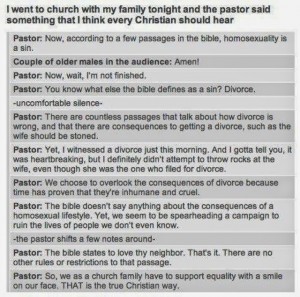
Love thy (gay) neighbor
I've been contemplating several Christian messages lately, looking especially for how Jesus treated the various individuals he encountered during his life. I've been moved by the treatment of a particular woman in John 8 who had been unfaithful—and everyone knew it. The religious leaders wanted to focus on the punishment for sin, but Jesus shifts the focus to the judgement being heaped upon her. Jesus lives the higher law here, choosing to love the woman instead of berating her for being an adulteress.

I think we can make an important connection between this vignette and the current treatment of our gay brothers and sisters, friends and family. In doing this, however, I do not want to be misunderstood. I want to be clear that I’m not comparing adultery and homosexuality; I am comparing two narratives of judgement. Jesus's point was that judgement of others (or in this instance—condemning sin in others) was a sin in and of itself.  The only time we should openly condemn sin is when we find it within ourselves.

While it's true this vignette portrays someone who actually was committing a sin, only he who was without sin could be the rightful judge. Most importantly, in preface to the connection I'm trying to make, just being gay is not a sin. We would do well to retire “love the sinner, hate the sin” in reference to homosexuals because, again, there is no sin in being gay. Traditional religious teachings that made this assumption have evolved, and current traditional assumptions are being challenged quite articulately here, I might add. I personally don’t think Jesus is overly concerned with our sexual orientation, but I’m convinced he definitely cares about us as individuals.

The impressive takeaway from this is Jesus's treatment of an individual to whom harsh judgement was being shown—particularly by the religious leaders. It was the religious leaders, after all, who brought the woman caught in adultery before him. Their treatment of her was most callous and demeaning, and they judged her behavior harshly. Regardless of how often the punishment was actually carried out, the Mosaic Law requires stoning for those who commit adultery (vs 5) and I almost get the sense that these men were enjoying the idea. Undoubtedly she would have been filled with fear and, because of such public shaming, humiliation. I imagine this to have been quite an intense moment…so how did Jesus respond?

His response was profound. He called for one without sin to cast the first stone (vs 7). Who would take responsibility for the judgement now? No doubt this caused them to reflect on their own sinfulness before God. The fact that the entire crowd ends up dispersing is an implicit confession of their own sins. By condemning another they would be condemning themselves.

In the end others opinions, accusations, shaming, and judgment will not matter anyway. Ultimately it's between Jesus and the individual. And in this case Jesus and the woman were left alone (vs 9). She, who is so vulnerable, comes face to face with the Vulnerable God himself. In this vulnerability there is love, and he alleviates her vulnerability and the shame she might feel by pointing out that her accusers had withdrawn—they too were not sinless (vs 10). He doesn’t even ask about the charges. Then he tells her: "Neither do I condemn thee: go, and sin no more" (8:11). Misery...meet mercy.

While Jesus may not have condoned her behavior, he most certainly did not condemn her. He showed compassion and love. That is what matters here—and that’s what matters today. It’s clear that when all of Jesus's life experiences and teachings are taken as a whole, he focused much of his time and energy on those in society who felt the most marginalized. The Parable of the Good Samaritan teaches that in order to be a good neighbor we must show mercy to even the most despised. I’ve felt for quite some time that we must model the Samaritan’s compassionate courage to our gay neighbors. Regardless of our personal comfort, he explicitly expects us to go and do likewise (Luke 10:37).

The experience with the woman taken in adultery captures as well as anything the essence of Christ's new covenant: we are supposed to be in the love business rather than the condemnation business. We can show love and compassion by being considerate of those who are hurting, mourning with those who mourn, rejoicing with those who rejoice, loving without conditions of worthiness, and being respectful of each individual—because above all they too are a child of God. We show compassion by communicating in a warm way, showing empathy, being kind, having genuine concern for the one, accepting people for who they are at their core, and doing no harm.

Jesus is not on record as ever teaching anything about homosexuality, but I like to think this experience should inform how we treat our gay brothers and sisters. Indeed, it should inform how we treat all our brothers and sisters. Put down our stones and show some compassion.
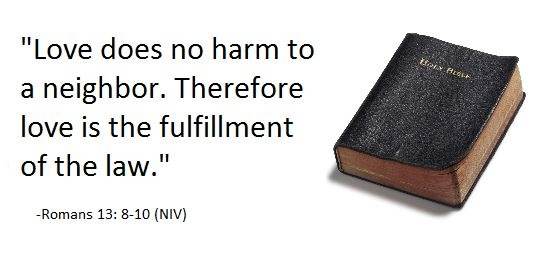
Love does no harm
What does it matter to us if the woman had been unfaithful? That's her burden to bear, her path to walk. No one is advocating for a life of sin followed by a get-out-of-jail-free card, but Jesus seems to be placing the emphasis on the importance of striving to be our best selves and extending mercy to everyone else. We each, in our own ways, are at times unfaithful to Christ and yet he loves us; he doesn't condemn us. "For God did not send his Son into the world to condemn the world, but in order that the world might be saved through him" (John 3:17 ESV). It is not our place to say what is or isn’t sin for someone else. Jesus is mighty to save, but ultimately that’s his job.

If Jesus himself declined to condemn an actual sinner caught “in the very act” (vs 4), then we certainly have no business making a point to express disapproval of anyone else’s life, homosexual or not. I’m pretty sure the only sin for which I will be held accountable is mine personally—whatever prevents me from being “at one” with God and my neighbor. He was pretty adamant that our greatest responsibility is just to love—love God and “love thy neighbor as thyself’ (Matthew 22: 35-40; Mark 12: 28-34).
Billboard
Does Jesus ever even mention to the woman what he personally thought about what she had done? He doesn’t have to—most likely she already knew what he believed. What’s most impressive is that he was more concerned with showing compassion to her, doing so both publicly and privately. Jesus then went on to teach that if we follow his example, we will not walk in darkness but have the light of life (John 8:12). Whatever that light-filled life means, it sounds like a much better way to live—for everyone involved.

It turns out that being about Jesus's and his Father's love business (and staying out of others business) is a really beautiful business to be in. Condemnation and judgement, on the other hand, are ugly—and a sin. Now, go and sin no more.