Showing posts with label Conscience. Show all posts

Wednesday, November 11, 2015

When The Mormon Church Was Dead Wrong And Too Stubborn to See It

This past week I've experienced a roller coaster of emotions. My wife and I welcomed a baby boy into our family. This most peaceful and good news was followed two days later by the sad and troubling news that our collective Mormon family will now officially exclude many (one is too many) priceless souls from joining the collective church family. Though the gospel of Jesus Christ is radically inclusive, the LDS Church is anything but. Even if you want to hope that the news is okay, you have to admit that the optics of this are brutal. And I'm left with the same question as Arwen Taylor, who hit the nail on the head:
Here's what I want to ask everyone who defends the new anti-gay family policy: What can you imagine the church doing that you would absolutely not support? Can you imagine the church taking an action that would cause you to say, 'No, this violates my conscience, this goes too far, this is not done in love?' Because if not, then you don't get to make moral arguments in support of this; you've ceded your moral reasoning to someone else's authority.
At every single juncture in the past we've been demonstrably wrong about homosexuality. A few months ago I implied my personal belief that our church persists in being wrong about homosexuality in a carefully worded open letter to Elder Christofferson. (A counselor in my stake presidency expressed concern to me about suggesting the Brethren are "wrong", but that just sparked another blog post on how if we acknowledge they're fallible then we should probably stop pretending that they can't be wrong.)

To learn of the problematic handbook changes feels like a sucker punch straight out of Salt Lake. And to be clear, my sorrow lies with Salt Lake, not my local ward and stake. My local leaders have been most loving and kind as well as inclusive and sensitive as we've counseled together. My loving stake president even reached out to me personally Saturday morning because he knew this would cause me great concern (like his counselor, he too had read my open letter to Elder Christofferson and we'd previously spoken in person about some of my concerns.) The thing is I haven't been able to respond--I'm too stunned. I think I'm going to need time to step back and take a sabbatical. In the meantime I simply wish to restate unequivocally my conviction that ALL families, regardless of the sexuality of the parents, deserve to be strengthened. Are we collectively too stubborn to see the harm the Church is now doing to real families and children? Even more sad than the handbook changes is to see so many loved ones try and defend it or pass the blame to God.


I thought we were learning to be better. I'm afraid I was wrong. This much is now clear: a significant number of Mormons--including Mormon leaders--have failed to learn some critical lessons from our collective past. One couple, in writing to their stake president, wondered about how some of the saddest episodes of our past may have played out differently if only someone had spoken truth and reason to power: 
Perhaps if someone in the Parowan and Cedar City stakes had had the courage to voice their opinion to their stake presidents in those fateful secret meetings back in 1857, the Mountain Meadows Massacre could have been avoided. Or perhaps if others in the Willie and Martin handcart companies had joined their voices with Levi Savage who warned against the late travel (and was severely chastised for not having faith in his leaders), the resulting suffering and death could have been prevented. Perhaps if church leaders in Brigham Young’s day had stood up to the policy change he instituted that denied blacks the priesthood and temple blessings (and which the church now acknowledges was based on racist cultural attitudes of that age), our church could have avoided causing untold emotional and spiritual injury to thousands of black people – as well as to the white members who perpetuated harmful racist attitudes (even to this day) because of the false folk doctrines they were taught in an attempt to justify an increasingly unjustifiable policy.
I sometimes wonder who, if anyone, has the ear of the First Presidency. I wonder if they're simply surrounded by "yes men" or if any have expressed to them concern about these handbook changes. I'm particularly concerned that they're not listening to our LGBT brothers and sisters. Most people don't get the chance nowadays to have the ear of the First Presidency directly. The distance can give the impression that the First Presidency doesn't need the collective wisdom of the rank and file church membership--apparently we are to presume inspiration despite a lacunae of any compelling evidence.

Moreover, despite President Uchtdorf's frank admission that there have been times when church leaders have made mistakes, too often we've been too stubborn to learn from those mistakes to be better in the present. Apparently leaders are also too stubborn to apologize for past wrongs. Of all the wisdom in The Lion King, this may be the ultimate: “The past can hurt. But the way I see it, you can either run from it, or learn from it.”
The Mormon Past Can Hurt (the Present too), But We Must Learn From It.


It is clear that many Mormons today still have much to learn from our past. I particularly have in mind The Stewart Udall Sequence--"a remarkable tale of conscientious dissent", which is filled with all kinds of customized lessons Latter-day Saints ought to be learning from today. Stewart Udall wasn't the only dissenting Mormon voice shamed for correctly following his conscience over the "authority" of church leaders. Readers of my blog may recall I once shared how brother Lowry Nelson had the ear of the First Presidency but they refused to allow themselves to question whether it was perhaps Nelson who was right while they were wrong. In fact history is filled with other Mormon voices who followed their conscience to dissent and have since been vindicated by history. But as a member of President John F. Kennedy's cabinet (Secretary of the Interior), Stewart Udall was likely the most prominent. I can't help but think about today's parallels and how Mormons who fail to remember the past are indeed condemned to repeat it.

It's already happening. On the one hand, there have been many Latter-day Saints who have responded with compassion and grace in the face of this weeks news. By far my favorite story comes from my friend Lon Young, who exemplified what it means to "mourn with those that mourn". On the other hand, this week I've heard/seen "Latter-day Saints" shame fellow Latter-day Saints for placing greater loyalty to following their own conscience over following LDS authorities. Though the nature of the issue is different, the behavior being exhibited and arguments being made today are almost exactly the same as those you can read in the saga of Stewart Udall (particularly parts 4 & 5), so without further ado, I present The Stewart Udall Sequence: a remarkable tale of conscientious dissent, written by a local friend of mine, Jonathan Streeter, here in San Antonio:


Part I: The Conscience of a Jack Mormon

Meet Stewart Udall and discover how he let his conscience guide his life. His deliberate decision to distance himself from the church is articulated in a note he wrote at the time. Those principles can be seen in his remarkable record of compassion.

Part II: Orthodoxy and Antipathy

When Secretary of Interior Stewart Udall took office, he received criticism about racist Mormon teachings. His exchange with the First Presidency reveals much about the perspective of Church leaders at the time.

Part III: The Letter

After seeing no change in church policy or teachings for years, Secretary of the Interior Stewart Udall writes an open letter condemning the priesthood ban and racist teachings. It did not go unnoticed.

Part IV: Who's On The Lord's Side Who?

After writing his letter, Stewart Udall received numerous letters from faithful Latter-day Saints. What does the content of those letters tell us about the heart of Mormonism regarding race at that time? (Spoiler alert: We're seeing today some of the same messages of chastisement: "Don't criticize the leadership," "Don't embarrass the Church," "Get out of the Church," "You're too prideful," etc. from both members and leaders.)

Part V: The Apostles and the Primitive Church

In addition to letters from other members, Stewart received letters from two Apostles. Would they echo the sentiments of the many members who castigated the outspoken Udall or take a different tone?

Part VI: By Their Fruits Ye Shall Know

The exchange between Udall and those who wrote him reveal the fruit that Mormonism bore in race relations. By examining 4 remarkable individuals at key points in the history of segregation, we may compare fruit and discover the lesson of Stewart Udall.

Thursday, October 1, 2015

LDS General Conference Is Great...Except For The Bad Parts

A metaphor for the Church itself?

Most Mormons view General Conference as quite a treat--I generally do. It's a special treat to stay home and watch conference in my pajamas on my comfortable leather couch. It's also a treat to spend uninterrupted hours with my family while seeking goodness, truth, and inspiration. For me personally, that goodness and inspiration comes most often in the form of the music we hear in General Conference. My experience has been that General Conference music is routinely exceptional--sometimes even supernal (a word sometimes used in conjunction with General Conference.) And from time to time there are a few talks that even reach that point for me. For example, these four from our last General Conference:
Of the latter I could hardly wait to blog about how it was itself a grace to me, like an oasis in the desert. I'm well aware, however, that since we all bring different background knowledge, experience, and even different lenses with us to General Conference, a "great" message to one can fall flat for another. This was brought home to me recently when my brother shared a talk he liked from that same conference in our family group text--Which Way Do You Face?. I didn't want to be a Debbie Downer, but my first instinct was to cringe and think of the Mormonad above. I decided, in the interest of fairness, I should re-read the talk to give it a second chance. There was, indeed, more relatively good stuff than I had remembered. My memory had only held onto the parts that had caused me concern. More on this in a minute.

First a disclaimer. I know most people aren't accustomed to watching General Conference like a film critic watches a movie, but it's a natural occupational hazard for those of us who've undergone a faith transition/transformation. I like the term "transformation" because I think of the metaphor of the caterpillar in its cocoon. The transformation can initially feel dark and lonely but like a butterfly, my personal faith came out on the other end more nuanced, colorful, and even beautiful. I admit it can be frustrating at times still when I encounter those who think I should act more like a caterpillar than the butterfly that's since taken flight.

I still use both my "mind and heart" in order to discern inspiration amongst the hours we spend in the buffet of messages known as General Conference. It's just that I can't quite bring myself to share in the same joy expressed by others who view everything in General Conference as "modern day revelation." My standard for "revelation" is much higher than that, and I would argue that Joseph Smith set the bar pretty high by publishing his revelations for all the world to see. Of course, one could claim that the LDS Church publishes the Ensign magazine for all the world to see, but what I clearly see is a huge difference between the revelations published in the Standard Works and what's published in the Ensign. Considering how little we Latter-day Saints have added to our "open" cannon since Joseph's day (at least the Brighamite branch of the Restoration movement), perhaps the "revelation" bar is too high for today's "prophets, seers, and revelators."

That's not to say that I can't enjoy goodness and inspiration in General Conference. It's just harder when I can't automatically take it all in as equally inspired. There's a lot of "good" in my church sundae, to be sure. But there's some very conspicuous "bad" that I cannot simply ignore.

As I follow the dictates of my conscience, I choose to magnify my individual responsibility to discern if what I'm hearing over the pulpit at any given time actually represents the mind and will of God. It's not an easy job, and naturally it's a subjective process, but all religion is subjective--all of it. And religion isn't supposed to be easy. It's supposed to challenge us, change us, and transform us into more compassionate beings--not passive sheep.

Neither am I passive while watching General Conference. Sometimes there are sermons meant to challenge us, and sometimes there are sermons that ought to be challenged. And as I read over the sermon my brother had recommended I found things that indeed resonated with me and that I generally found inspiring. This quote, for example, was great and still resonates with me: "Trying to please others before pleasing God is inverting the first and second great commandments." That's great advice to put God first over other men/women, and I include in that even institutions such as the LDS Church.

But I also found some things that caused me concern. The first cringe moment came in the form of a quote by the late Boyd K. Packer: “A Seventy does not represent the people to the prophet but the prophet to the people. Never forget which way you face!” This viewpoint is one of a top-down-only hierarchy--a viewpoint which happens to be one of the things I least like about the current institutional church. That top-down-only attitude completely misses an opportunity to have good counsel between everybody else not already in the leadership-hierarchy flow chart. It also contradicts the way things are supposed to work at the local level in terms of ward and stake councils.

But I had stronger reservations with this part: "Thinking one can please God and at the same time condone the disobedience of men isn’t neutrality but duplicity, or being two-faced or trying to “serve two masters” (Matthew 6:24; 3 Nephi 13:24). The obsession with making clear what you condemn or condone in others gets in the way of true compassion, and I believe that can be sin in and of itself. I don't accept the false dichotomy that you're either "for us or against us", the conflation of prophets with God (implied throughout), and also the preoccupation with righteousness and purity.

While Mormons traditionally place much emphasis on righteousness and purity, Jesus himself was historically subversive to the righteousness/purity system of the contemporary religious establishment. I saw this very clearly while reading Marcus Borg's Meeting Jesus Again for the First Time: The Historical Jesus and the Heart of Contemporary Faith. "Compassion, not holiness, is the dominant quality of God, and is therefore to be the ethos of the community that mirrors God" (Borg, p. 54.) In other words, "an interpretation of scripture faithful to Jesus and the early Christian movement sees the Bible through the lens of compassion, not purity." Borg uses a specific example on page 59:
I am convinced that much of the strongly negative attitude toward homosexuality on the part of some Christians has arisen because, in addition to whatever nonreligious homophobic reasons may be involved, homosexuality is seen (often unconsciously) as a purity issue. For these Christians, there's something "dirty" about it, boundaries are being crossed, things are being put together that do not belong together, and so forth. Indeed, homosexuality was a purity issue in ancient Judaism. The prohibition against it is found in the purity laws of the book of Leviticus. 
It seems to me that the shattering of purity boundaries by both Jesus and Paul should also apply to the purity code's perception of homosexuality. Homosexual behavior should therefore be evaluated by the same criteria as heterosexual behavior. It also seems to me that the passage [Galatians 3:28] in which Paul negates the other central polarities of his world also means, "In Christ, there is neither straight nor gay." Granted, Paul didn't say that, but the logic of "life in the spirit" and the ethos of compassion imply it.
When I watch General Conference now, I can't help but take issue with various "purity" interpretations. For example, from the same talk my brother sent: "Lowering the Lord’s standards to the level of a society’s inappropriate behavior is—apostasy." 

Let me be clear: I have no problem accepting that the Lord has standards that are unchanging and wise. However, our human understanding of the Lord's standards is imperfect and is always filtered through a human brain. History teaches that we've been wrong about His will before. And history doesn't hide the fact that sometimes regular Mormons have greater insight into truth than those sustained as "prophets, seers, and revelators." [See here and especially here, for example.] Our understanding of the Lord's will and His standards constantly evolve and change as we receive greater light and knowledge. And hopefully our moral conscience continues to evolve.

Elder Robbins also makes his own definition of apostasy, and my personal concern is that his statement of what constitutes "apostasy" will be used as ammunition to expel dissenters like me from the body of Christ, not to mention if it even aligns with the explanation of apostasy given recently by the First Presidency of the Church.

Last point of concern: "When others demand approval in defiance of God’s commandments, may we always remember whose disciples we are."

The problem for me isn't forgetting that I'm first and foremost a disciple of Christ/God; the problem is that "God's commandments" have always been interpreted and declared by imperfect human filters, and fallible men often misinterpret/mistake the Divine will. I remember like it was yesterday a General Conference five years ago where I surprised myself by reflexively shouting "That's not right!" as soon as President Packer shared a personal opinion about how homosexuality fit into God's plan. His talk was edited by the time it came out in the print version a few days later.

It's my opinion (and I'm entitled to my own opinion) that just as the Church now "disavows the theories advanced in the past" (such as that interracial marriage was a sin, which was declared to be "doctrine" according to some general authorities in the not too distant past), I personally believe there will come a day when the future Church disavows current teachings that being a happily married gay person was a "sin." Of all people, Mormons with a messy polygamous past probably shouldn't be painting with such a broad brush as though we've figured out the full picture clearly.

love the Brethren, but I disagree that there are no acceptable ways to act on one's homosexuality without it being inherently sinful. My love for the Brethren is not conditional based on whether I agree or disagree with them about homosexuality. I think Mormons who believe that the Church's current stance is "right" deserve for me to show them true love and compassion, regardless of the fact that I disagree with the Church's current stance. It's easier to love people who think like you. But that's why I personally think I need the Church in my life, not because I always think alike, but because I need to learn to love people who are radically different than me.

Of course, ultimately we're all more alike than we are different, whether in or out of the Church. People historically have killed each other over believing the "right" dogma or over behavior deemed "inappropriate" in God's eyes. That's a shame. I believe we mustn't let dogma get in the way of love. Compassion must always come first. Love can be the bridge between people who disagree on dogma (and is preferable than killing, shaming, or even excommunicating people over differences in belief.)

In the mean time, drawing these artificial lines in the sand causes real pain and harm. I believe it to be imperative that we be more focused on inclusiveness and compassion over righteousness and exclusivity. Our differences in belief don't need to matter when we focus on loving each other through Christ's compassionate lens. I hope we can all agree that Christ's main message is one of love and compassion rather than judging others according to our church's current standard of "sin."

Because I believe, with Richard Poll, "that everyone, including Paul and other prophets, sees eternity 'through a glass darkly' (l Cor. 13:12), prophetic infallibility, scriptural inerrancy and unquestioning obedience are not elements of my faith." And that's why I approach General Conference the way I do. If one were to just assume that what we're hearing in General Conference automatically represents the mind and will of God, one is primed to be led astray. Despite frequent assurances that Mormon prophets can't lead us astray, history proves that myth wrong. The scriptures themselves prove the myth of infallibility wrong, yet in spite of common sense, many Mormons continue to imply infallibility without even realizing it--with very striking consequences. Our shared fallibility makes embracing compassion and grace all the more important.

So yes, church really is great, except for the bad parts. We can't expect perfection when the church is made up entirely of human beings. We need to be supportive of each other, especially in our weakness. Last spring I participated in podcast interview about my current faith and some of the difficulties I face within the institutional church. (If you're interested in listening, my segment's in part one of episode 096: Hard to Stay – Harder to Leave and begins at the 29:10 minute mark.) A friend of mine who found the "A Thoughtful Faith" podcast valuable transcribed a quote of mine. I thought I'd include it here for any who may question why I remain in the LDS Church feeling the way I do:
There is something to be said of community. I want to stay in the church because it is a support community of people trying to seek Christ. Not because it’s perfect, because it’s not. And not because it has all the truth, because it doesn’t. But because it can be a good support network to people who are trying to love each other and follow Christ. As long as that’s the case, it’s great. 
But when it starts to get an unhealthy over-emphasis on "follow the prophet, follow the prophet" and all this other business like gender inequality (that frustrates me and I wish we'd change quicker), then that makes it harder to stay. Especially I have hope on the LGBT issue that the church will one day wake up and realize: "Hey, the gospel includes everybody, the gospel is for everybody. Our church though--our policies--are keeping people away. And we're going to continue to lose people and the church might just hollow out unless it adapts. But history gives me hope that it will adapt. It's just sometimes slow to adapt." [ends at 52:48
Unapologetically I embrace whatever is good and I reject whatever causes harm. Mormonism is a sausage makers religion and we each choose for ourselves what speaks to our conscience and what violates our conscience. Whether in this church, another church, or no church at all--the bottom line is all the same. The bottom line is learning to love everyone (even those radically different than ourselves) and serve and do some good. I find that in this church. It may not always be comfortable, but I'm still onboard.

Brigham Young once famously said of a great valley with a few bad parts: "This is the right place. Drive on.” That pretty much sums up how I currently feel about my membership in the institutional church. I particularly love how Sharon Eubank put it last year:
The right place doesn’t mean there is not going to be blinding salt flats and black crickets and all kinds of naysayers and killing frosts and all of those things. But it is still the right place. And I also think we ought to be probably driving on. Rolling up our sleeves and doing the thing that our doctrine allows us to do which is to say: Everybody is valuable. Everybody has unique individual gifts. The Lord’s plan allows for everybody to use their gifts. I can be respectful. I have responsibility to do it and I’m going to roll up my sleeves and go to work.

Wednesday, June 3, 2015

If you could ask the First Presidency a question--any question--what would you ask?


"If we have the truth, it cannot be harmed by investigation. If we have not the truth, it ought to be harmed."
-J. Reuben Clark

I'm genuinely baffled when I see fellow Latter-day Saints dismiss any effort to ask hard questions, especially when those questions are an honest attempt to find out what "the truth" is. In a church that only requires us to believe "truth", why is the default setting to view such attempts that dig deep to find out "the truth" perceived as "negativity" and a threat?

If one uses a jackhammer to try and separate fact/truth/ideal from the concrete of reality, tradition, and even current teachings assumed to be truth, I think we should be thankful for such work, not marginalize the worker because of the temporary noise.

Assuming we could ask in that spirit and receive a loving answer (as opposed to being given a stone for bread), I'm wondering what you would ask the First Presidency if you had the opportunity to ask any question you wanted?

I have several questions I'd like answered. For example:

*Why are only men ordained to the priesthood?
*When will you be reforming the excommunication process?
*Why in the world did you uphold Kate Kelly's excommunication anyway?  What was learned, if anything, when the Church botched that "sad experience"?

I'm in complete agreement with Lavina Fielding Anderson (who herself was wrongfully excommunicated), who last summer at Sunstone shared the following:
One of my personal insights is support for the order the church has established about the relationship between stewardship and revelation. I have no problem with assigning responsibility for church-wide revelation to the men who hold the office of apostle and prophet, but I can’t describe the pain I feel that those who claim the privilege of revelation seem to refuse the responsibility to seek it. Our church claims continuous revelation, yet it punishes those who implore its leaders to seek it. Some of the most horrifying statements and silences to come out of Kate [Kelly’s] excommunication is the denial that there is anything to pray about or any point on which further revelation should be sought. 
I feel such longing when I read calls from Steve Veazey (prophet and president of the Community of Christ) for the whole church to join in a discernment process. What if our leaders similarly ask its members to pray earnestly about ordaining women to priesthood? About supporting and celebrating our gay and lesbian brothers and sisters who want to marry, have families, and participate in congregational life? What if our leaders really accepted Nephi’s assurance and invited us to join with him in the call: Christ "denieth none that come unto Him, black and white, bond and free, male and female...all are alike unto God.” (From Lavina's remarks at minute 10:35-12:16 of Session 324: "Life After Church Discipline.")
Hers is a profound insight and something I too long for. But great is the letdown I feel when I contrast that with the way kangaroo "courts of love" have started popping up in our church like whack-a-mole. Tonight in Sacramento, California, Rock Waterman is being charged with "conduct unbecoming a member of the church" and thus an "apostate" who'll likely be excommunicated. Last month it was the Calderwoods, who perhaps believed too little; today it's Rock Waterman, who believes too much. Joseph Smith once said: “I never hear of a man being damned for believing too much; but they are damned for unbelief.” Go figure.

***Update 6/4/15: Rock posted the following update to this blog a few hours ago:
A few hours ago I was excommunicated from the church for apostasy.
"What sins am I guilty of?"
"Apostasy."
"No, apostasy is your judgment. What sins have I committed that make up this apostasy?"
"Apostasy is the sin."
One truth has come home to me with laser clarity: there are two religions operating side by side in the LDS church today, both vying for dominance. The first is the religion founded through Joseph Smith, which emphasizes dependence on Christ. The other religion requires allegiance to Church leaders above all else. If your devotion to Jesus is stronger than your fealty to the Church hierarchy, you are a threat to their system.
It doesn't matter how forcefully you bear testimony of Christ and His gospel; the Brethren-ite religion has but one focus: replace the organic religion with the counterfeit one, all the while convincing followers nothing has changed.
You know what I think is truly "unbecoming"? Modern day witch hunts are unbecoming of the Church of Jesus Christ. Yet they're allowed to take place without much second-guessing, despite the fact we've been reminded the Church has and can make mistakes. One cannot "repent" of the truth, nor from the fact that some people with misguided loyalty/allegiance either don't want to hear the truth or see it as a threat. Our loyalty should be to the truth. Truth is truth, no matter who speaks it. Truth isn't any more "true" whether it's spoken by authorities or academics. We have to be able to discern the truth for ourselves.

Rock Waterman is a "threat" in the same way Dorothy pulling back the curtain was a threat to the Wizard of Oz. The question is do we want to see the truth and see reality as it actually is or as we wish it to be? Truth can defend itself--it's not a fragile thing. If people have faith in the truth there is nothing to fear. But if expectations of faith are placed upon a false narrative or on idols, then image must be preserved at all costs. Despite these unjust, unfair, and unChristlike witch hunts, leadership typically remains silent, unless media attention becomes great. It was a rare and welcome exception when the First Presidency issued this statement last summer:
Simply asking questions has never constituted apostasy. Apostasy is repeatedly acting in clear, open, and deliberate public opposition to the Church or its faithful leaders, or persisting, after receiving counsel, in teaching false doctrine.
I, for one, don't oppose the church or its leaders. In fact, I sustain them. But since sustaining them doesn't require that I always agree, I do oppose the harmful messages and teachings that sometimes come out of the church and its faithful leaders. Harmful teachings deserve to be harmed. (If you're not prepared to go down the rabbit hole, don't ask me for specific examples. There are plenty, both in the past and in the present.)

To be clear, don't believe we should ever criticize the leaders themselves. Personal attacks are certainly unbecoming a member of the church. As L. Jackson Newell wrote: "Personal attacks always diminish the dignity of individual and community life and are never appropriate in government, business, or religion. On the other hand, the respectful and constructive criticism of a leader's ideas or judgments is not only acceptable but necessary for healthy organizational life." Thus, I draw an important distinction between the person and the ideas. We should constructively criticize ideas and teachings that are harmful. I'm with Bill Reel on speaking out against harmful and damaging teachings--especially when lives are at stake or the atonement is denied. (Better to come home dead from your mission than to have committed sexual sin?! What about the atonement?!)

I dislike false doctrine as much as the next guy. I especially dislike it when it comes from authorities of my church. Thus, I support the church when it corrects its own false doctrines and false teachings, however long it takes. (Example: Race and the priesthood.) Since the church itself can eventually come around and correct its mistakes (with or without apologies) and receive grace, perhaps we ought to be willing to extend the same hope and grace to individuals to likewise come around eventually and not be so swift to judge them as apostates and excommunicate them.

In light of the First Presidency's reminder that "simply asking questions has never constituted apostasy," I posed my original question ("If you could ask the First Presidency a question--any question--what would you ask?") to fellow Latter-day Saints online. I quickly received many responses, and you'll see from their questions below that they are not afraid to think for themselves and question the status quo. It's quite a sampling:
  • "If the gospel is truly for everyone, what is the church willing to do to change the culture of Mormonism so that everyone will feel they truly have a place here regardless of color, sexual orientation, political affiliation, gender, marital status, social class, etc.. ?"
  • "Why can't we let Jesus be enough? If it's His gospel, why don't teach that more?" 
  • "Why do we need to constantly add in things to the gospel plan? Isn't the atonement good enough?" 
  • "Why are you directing people not to follow the Savior's commandment to ASK, SEEK, KNOCK? Regarding female ordination, what are you afraid of?"
  • "Why can't we be okay as a church admitting there have been lies, white washing, and deliberate half truths in the name of building a church?"
  • "If the Book of Mormon holds the fullness of the gospel, why do we have a very different church now? I am comfortable with modern revelation but we have departed so much from the church described in the Book of Mormon."
  • "What do you mean, 'you KNOW'?"
  • "What do you honestly think about polygamy? Why not just abolish section 132?"
  • "Can we have that long awaited two hour block? Pleaseandthankyou."
  • "Why do you allow yourselves to be put up on pedestals? (I personally think the deification of members of the church serving in "high callings" is a root problem to a lot of the ill's of the church. A hierarchy invalidates a lot of voices.)"
  • "Why is it that in some cases putting leaders on pedestals is actually encouraged or even demanded, and why are general authorities allowed to do it to each other? (The 14 Fundamentals and its inclusion in manuals and reiteration in conference makes top leadership complicit in fostering the idolatrous culture.)"
  • "Why have the 15 apparently decided they should not apologize for wrongs done in the past or today?"
  • "What are we to do with 2 Nephi 5, Alma 3, Abraham 1, Moses 7, and other scriptures in relation to the church's statement: 'Today, the Church disavows the theories advanced in the past that black skin is a sign of divine disfavor or curse'?"
  • "When is the church going to be honest about its history? Why can't we apologize for what happened in the past? Our church clearly hasn't been Christlike in how we treat the LGBT community. And why is the church excommunicating people based on belief, not actions that are detrimental to the gospel?"
Of course, last summers clarification that simply asking questions is not apostasy wasn't necessarily a new definition of apostasy, since the following has long been in the handbook:
Yet the handbook can raise more questions than it answers: Is excommunication truly warranted in cases where one man judges another as "apostate" for believing too much or too little? How can one repent of something that was never sin to begin with?

I would whole-heartedly support the Church in making progressive changes to this definition and/or process. In light of the ninth article of faith, I wish the Church would not be so collectively resistant to change. Recently on Radio West, Greg Prince summed it up like this: "We feel very strong about how things are until they change, and then we feel very strong about how they’ve become." And later: "We feel very strongly that we do things the way we do them because we do them that way until we do them differently."

Should we not hope that Seers could see a better way forward in cases where deep and serious sin has not occurred? Is excommunication truly the best solution for these kinds of cases? Do we not see how foolish it is to continue to use excommunication as the red "ejector" button, rather than exclusively for repentance in serious moral and ethical cases? Moreover, isn't it troubling how "conduct unbecoming of church members" is subjective in the extreme, how there's no impartial jury, and that no women are allowed to be part of the council?

No amount of faith will change the stubborn fact that some members are not as lucky as others in the unfortunate reality of ecclesiastical roulette. Perhaps to create more calm and uniformity the First Presidency could require that they themselves must sign off on these kinds of cases rather than let local leaders fumble around and inflict pain on the worldwide church body.

Another question: What of those who hold up a mirror on ecclesiastical abuses in the institutional Church? If we don't like what we see, do we punish the messenger for the message? Are we okay with casting out those who speak out publicly while injustice is swept under the rug to save the reputation of the Church? Are we okay with "disciplining" those who follow the dictates of their conscience? Do we really expect all such displays of ecclesiastical "power" to be automatically and divinely ratified? If the Church is concerned about its reputation, shouldn't it allow people of conscience to become whistle-blowers in order to uncover unrighteous dominion? Does it not create an unsafe environment when the default is to squelch public dissent?

If our ultimate responsibility is to truth, do we not have the right and the responsibility to respectfully oppose teachings we've individually discerned do not represent the mind and will of God? How much faith do we actually have in J. Reuben Clark's statement: "If we have the truth, it cannot be harmed by investigation. If we have not the truth, it ought to be harmed"? Does confirming the truth for one's self only apply to sincere investigators before they're baptized or all throughout their lives? Are we expected to turn a blind eye to history and believe the myth of infallibility, that authorities called of God always speak the truth?

I believe Terryl Givens spoke truth when he said the following:
We believe that it is always our responsibility to confirm through our own study and prayer and responsiveness to the spirit, whether what we’re hearing, is the mind and will of the Lord or not. I think of Orson Pratt who alone of twelve apostles refused to consent to the false doctrine of Adam-God and only many years later was vindicated for his steadfast integrity. So it may be that in the short term we do find ourselves on the margins or ostracized but I think that our devotion always has to be first and foremost to our conscience, before to any institution. (Mormon Stories Podcast episode 496--part 2: Fiona and Terryl Givens and “The Crucible of Doubt”--1 hour 33 minute mark.)
If I had a more sure hope in church leaders always doing the right thing (ie: if I ignored D&C 121:39), then perhaps I wouldn't feel compelled to speak up and voice the concerns of my conscience. But I must place loyalty to conscience over loyalty to any institution, and my conscience tells me something is seriously wrong with the way excommunications for "apostasy" are taking place. As Joseph Smith said:
I never thought it was right to call up a man and try him because he erred in doctrine, it looks too much like methodism and not like Latter day Saintism. Methodists have creeds which a man must believe or be kicked out of their church. I want the liberty of believing as I please, it feels so good not to be tramelled. (Joseph Smith, WoJS, 183-84.)
Most of us Latter-day Saints live in a state of privilege; because we ourselves don't feel trammelled we may conclude it's not really a problem for anyone else. But to "try" others because one has judged them as having "erred in doctrine" is trammeling. There are better ways to handle differences of belief than having someone in a position of "a little authority, as they suppose", press the ejector button. The scriptures teach us the "more excellent way" is to love the person and perhaps even seek to understand rather than be so quick to judge. As a matter of fact, judging them prevents us from fulfilling the greater commandment to love them. President Thomas S. Monson confirmed this:
Mother Teresa, a Catholic nun who worked among the poor in India most of her life, spoke this profound truth: "If you judge people, you have no time to love them." The Savior has admonished, "This is my commandment, that ye love one another, as I have loved you." I ask: can we love one another, as the Savior has commanded, if we judge each other? And I answer—with Mother Teresa: no, we cannot.
If this is true on an individual level, would not the same hold true on an institutional level? How are we to reconcile this with our current conception of "judges in Israel"? While I don't claim to know how to answer that, a wise stake president once said: "Being a judge in Israel does not exempt me from the commandment to love one another. It binds me to it. To be a judge in Israel is to help [people] come unto Christ and repent of their sins. It has nothing to do with assigning guilt. There is many a time I know of sin and do nothing. My responsibility kicks in when an individual desires to repent."

Precisely because no one single mortal can know all the details of ones heart, wouldn't it be better to leave the judgement up to Christ? Last June in her Sunstone presentation, Lavina Fielding Anderson quoted Pope Francis, who just days before had given a homily based on the parable of the mote and the beam and had renounced those who judge others, calling them hypocrites and even comparing them to Satan. He pointed out the scriptural fact that the title of Satan is “the accuser.”

He who judges another puts himself in the role of God, the only judge--and is that not a form of blasphemy? Even with an exclusive claim to priesthood authority, if we see no difference between mortal leaders and God himself, that is idolatry. A man so certain he knows the will of God can be dangerous.
That danger should give us pause, cause us to think deeply, and to be very careful, for whichever judgment we dole out will be the judgement we too will receive. What happens to the brother who judges, as Pope Francis said, is that he ends up "a victim of his own lack of mercy." Speaking on mercy, the Pope went on to say that Jesus "never accuses" but actually does the opposite--he defends. “Jesus will judge, yes, at the end of the world, but in the meantime He intercedes and defends."

God is "the sole judge" and ultimately, said Pope Francis, men who judge “imitate the prince of this world," who waits in the background, ready to accuse. “May the Lord give us the grace to imitate Jesus, the intercessor, advocate, lawyer,” for ourselves and others. We're to imitate Him, not imitate others who judge, for “in the end, it will destroy us." After quoting the Pope, Lavina went on to say:
Meantime, those who judge, who accuse, who bully, who cut off sincere discussion, who silence honest questions, who cast the sufferers out of the community--they claim to speak in the name of God. They may be among those to whom Jesus will say: "Depart from me, I never knew you," or as the Joseph Smith Translation reads "Ye never knew me.” May we cling to Christ, be open to his grace, and have the blessing of being forgiven of our own trespasses as we forgive those who trespass against us.

Monday, March 9, 2015

"I will not seek to compel any man to believe as I do, only by the force of reasoning, for truth will cut its own way.”

"The Lord Himself does not attempt coercion in His desire and effort to give peace and salvation to His children. He gives the principles of life and true progress, but leaves every person free to choose or to reject His teachings. This plan the Authorities of the Church try to follow.  
The Prophet Joseph Smith once said: “I want liberty of thinking and believing as I please.” This liberty he and his successors in the leadership of the Church have granted to every other member thereof… 
Again, as recorded in the History of the Church (Volume 5, page 498 [499] Joseph Smith said further: “If I esteem mankind to be in error, shall I bear them down? No. I will lift them up, and in their own way too, if I cannot persuade them my way is better; and I will not seek to compel any man to believe as I do, only by the force of reasoning, for truth will cut its own way.” 
...In the advocacy of this principle leaders of the Church not only join congregations in singing but quote frequently the following: 
“Know this, that every soul is free
To choose his life and what he’ll be,
For this eternal truth is given
That God will force no man to heaven.”
And yet today, in 2015, I'm afraid that masterful message still has not permeated our church the way it needs to--filtered through to all layperson and leader entrusted to administer the church. There continue to be pockets of LDS "leaders" who still think it their duty to compel and coerce the Latter-day Saints into believing one way or another.

This week a Mormon man in Missouri was threatened with excommunication unless he takes down his blog post. In my eyes his blog post holds up a magnifying glass to a revelation I myself have expressed serious concerns with after having actually tried to read it objectively. As Joseph Smith said: "Truth will cut its own way," and Kirk Van Allen's post was a confirmation of the truth about my concerns--and then some. In short, it's a thorough and well-written close up look at Section 132--the revelation on plural marriage. I wish I had written it myself, since my conscience tells me to embrace all truth not just convenient truth, and in my view Kirk exposes the truth.

Even if Kirk's logic was faulty and his ideas completely based in ignorance, President David O. McKay insisted that a man in this Church had a right to believe as he pleased. Thus, even if I hated Kirk's post and totally disagreed with it, the ultimatum to remove it under disciplinary threat flies in the face of the 11th Article of Faith, which claims for each individual the privilege of following "the dictates of our own conscience" and believing "how, where, or what they may."

This kind of religious persecution needs to be exposed for what it is: an attack on the "timeless argument which connects the dignity of human life with respect for individuals and their right to think and act from an informed, reflective, and even prayerful conscience." I say these things and publish my thoughts because, along with Stephen L Richards (who ended up serving as a counselor to David O. McKay in the First Presidency) "I fear dictatorial dogmatism, rigidity of procedure and intolerance even more than I fear" the idea that not all scripture in our cannon is equally inspired.

I feel compelled to stand for freedom of conscience. And I stand with the confidence of Hugh B. Brown (another counselor to David O. McKay in the First Presidency), who called each person to "exercise your God-given right to think through every proposition that is submitted to you and to be unafraid to express your opinions, with proper respect for those to whom you talk and proper acknowledgment of your own shortcomings." Calling for the preservation of freedom of the mind "in education and in religion", President Brown said: "We are not so much concerned with whether your thoughts are orthodox or heterodox as we are that you shall have thoughts."

In another masterful address of his own, President Brown expressed: 
We should, of course, respect the opinions of others, but we should also be unafraid to dissent–if we are informed. Thoughts and expressions compete in the marketplace of thought, and in that competition truth emerges triumphant. Only error fears freedom of expression… This free exchange of ideas is not to be deplored as long as men and women remain humble and teachable. Neither fear of consequence or any kind of coercion should ever be used to secure uniformity of thought in the church. People should express their problems and opinions and be unafraid to think without fear of ill consequences. … We must preserve freedom of the mind in the church and resist all efforts to suppress it.”
He reiterated this all again in his "final testimony"--the last chapter of his memoir. I would like to believe that church leaders today understand President Brown's prophetic voice, but in light of "leader routlette" I don't believe it with much confidence. I do believe with confidence that most priesthood leaders read Doctrine and Covenants 121:41-42 and sincerely desire to lead in their calling "by persuasion, by long-suffering, by gentleness and meekness, and by love unfeigned; By kindness, and pure knowledge, which shall greatly enlarge the soul without hypocrisy, and without guile." Yet, because it is "the nature and disposition" of almost all of them to be easily prone to "unrighteous dominion", I also have a healthy respect for the fact that "many are called, but few are chosen."

Cracking down on a faithful member of the church following the dictates of their conscience and blogging about truth as they understand it, even if it makes some uncomfortable, is the very definition of dictatorial dogmatism, rigidity of procedure, intolerance, and unrighteous dominion. The irony is that actually reading the blog with an open mind might lead to learning something new, or at least allow one to better confront "wrong thinking." Even more ironic is the fact that the LDS Church today would excommunicate someone for believing and practicing polygamy, but Kirk is being threatened with excommunication for disbelieving polygamy and speaking against it as an inspired practice. 

In October of last year I published my opinion that plural marriage wasn't inspired by God and even expressed concerns with D&C 132. I wrote: "It's hard for me to believe a loving God threatening that Emma would be 'destroyed' if she didn't accept polygamy. Some Mormons might embrace this Old Testament-like voice of God without a problem. I tend to blame the heavy-handedness on the human filter dictating the revelation--and maybe not getting the language quite right. Hard to 'feel the Spirit' in that section." Kirk's post helps me (and others as far away as New Zealand) understand why that particular section doesn't pass the "fruits of the spirit" test.

I recall Mitt Romney, being interviewed by Mike Wallace on 60 Minutes, voicing his personal opinion on national television: “I can't imagine anything more awful than polygamy”. Would that we could all feel free to likewise publicly speak our minds, even if it's to say that we can't imagine any revelation more awful than D&C 132. Joseph Smith was once said to have expressed the following: "Some revelations are of God: some revelations are of men: and some revelations are of the devil." Regardless of the accuracy of that quote, Kirk and I share the opinion that it feels more of a revelation of man than of God.

Lester E. Bush was ostracized for publishing his landmark article "Mormonism's Negro Doctrine: An Historical Overview." Today we think of him as a hero because he spoke the truth, even when the truth wasn't convenient for the Church. Exposing the history was a huge piece of the puzzle that eventually led to the 1978 revelation on the priesthood. Because the truth he exposed in his article went against the traditional narrative at the time, which turned out to be wrong, he was shunned by LDS ecclesiastical leaders and "Lester and his family withdrew quietly but completely from church activity, the tragic side of 'the long-promised day'.”

I think we all need to apply what Darius Gray once said about facing up to this difficult episode of our history: "The issue isn’t about finding fault but about learning to be better...For those who feel you are defending the Church please know you are not alone. I have defended it for nearly 42 years and have zero interest in causing any harm...However, I do hope that we, as an institution and as individuals, can come to understand that false teachings are still very much with us and that it is required of us to seek truth — and to speak truth."

If we're self-critical and honest about the past and our history, the truth is that the fruits of polygamy have largely been negative. I can’t bring myself to believe that D&C 132 represents God's true voice even if I wanted to--even if social pressure would make it tempting to just go along with it. My conscience can't accept it as coming from a loving God and no "loving" threat of excommunication can change that. Should I be excommunicated for sharing this opinion? The whole question is ridiculous to me and yet it's Kirk's reality right now. I am not out to inspire negativity--I want to inspire truth seeking. I’ll be damned if I sit back idly and fail to apply the lessons of the past whenever group-thinking and towing the line is enforced, regardless of what individual conscience says. Therefore, in solidarity, I republish the original post (with permission) below: 


D&C 132: A revelation of men, not God


 solomons-wives-and-idolatry 

What I’m about to say to you may seem shocking, but please read through it completely to understand where I am coming from.  I have come to the belief that D&C 132 and Joseph’s teaching of polygamy isn’t, wasn’t, and never will be revelation of God, that polygamy is not of God but rather an idea of men. I believe that it is self-evident that a loving God would not be the author of such confusion, obvious inequality, and emotionally/psychological damage.  I believe firmly that if there ever was a practice and verse of scripture that has failed the test of fruits of the spirit, D&C 132 and polygamy would be a sure bet.
Galatians 5 reads:
22 But the fruit of the Spirit is love, joy, peace, longsuffering, gentleness, goodness, faith,
23 Meekness, temperance: against such there is no law.
Yet, apparently in Mormondom there is a law that does not mesh with the fruits of the spirit. That law is plural marriage. It is a subject that causes many peoples’ stomachs to wrench with disgust. It is a topic that is avoided and often disregarded as something that only God understands, yet plural marriage has and continues to affect the lives of every Latter-day Saint. You don’t believe me?
In my own life my parents had taught me that polygamy was the marriage system of heaven. My mother would say, “How else would Heavenly Mother be able to give birth to billions of spirit children, unless she did not have fellow women to help her?” People in my very Mormon community would say things like, “When they bring back polygamy…..” or “If the prophet asked you to practice polygamy, would you do it?”, as if it would be the ultimate faith and devotion to God. My wife has even more disturbing experiences.  She was taught that the more righteous the man, the more wives he would have in the life to come.  This created a harsh dichotomy in her mind.  She wanted to marry a righteous man and yet didn’t want to share her husband in polygamous heaven.  She was told that it was a principle designed to teach women humility and to overcome jealousy.  (Because no man would ever be jealous or upset over having to share his spouse.)  I’m sure Mormon readers, especially women, have stories of your own. The doctrine of plural marriage continues to deeply affecting much of the church culture to this day. From the way we treat women, to the way church business is conducted, to temple practices, plural marriage still colors the filter we look through. If you do not believe me, you need to follow this link to learn more.
The reason I have decided to write this post is to stand up for the women hurting from this painful teaching. I’m doing it for my posterity, so they will know where I stood on the issue. And I’m doing it for every polygamous wife that has ever felt the agony of watching their spouse kiss and love another woman.  I’m doing this for every faithful woman that wrestles with the tortuous thought of a polygamous “heaven”. I’m doing this in an effort to help people realize, that with honest study and prayer, you can come to see that polygamy should be thrown into the dust bin of mistakes, never to be resurrected again, and that those rejecting polygamy still remain faithful to God. Let me show you why I believe what I believe-
MONOGAMY
From personal experience, members of the Church of Jesus Christ of Latter-day Saints have always been of the opinion that a primary purpose of polygamy was to bring forth more children. God requires polygamy to raise up a righteous generation, yet God has shown in scriptures that monogamous couples are preferred for the of start civilizations, dispensations, and righteous generations.
Adam and Eve, the first people.
Genesis 2
 23 And Adam said, This is now bone of my bones, and flesh of my flesh: she shall be called Woman, because she was taken out of Man.
24 Therefore shall a man leave his father and his mother, and shall cleave unto his wife: and they shall be one flesh.
Noah and his wife, our first parents after the flood that destroyed mankind.
Genesis 7
There went in two and two unto Noah into the ark, the male and the female, as God had commanded Noah…
13 In the selfsame day entered Noah, and Shem, and Ham, and Japheth, the sons of Noah, and Noah’s wife, and the three wives of his sons with them, into the ark;
Lehi and Sariah, the first parents of the ancient Americas
1 Nephi 1
5…and he did travel in the wilderness with his family, which consisted of my mother, Sariah, and my elder brothers, who were Laman, Lemuel, and Sam.
In each case Adam, Noah, and Lehi all had one wife at a time. When there was dire need to repopulate the Earth with a righteous population, these men found that a loving equal was all that they needed to brave a new world. The scriptures continue to support monogamy in D&C 42:22, 1 Timothy 3:2,12, D&C 49:16, Jacob 2 and 3, Ephesians 5:31 and the list goes on. There are many scriptures that support the overarching idea that a man should cleave unto one woman and none else.
Science, itself, has shown that those in polygamous relationships have less children than monogamous couples would.  For example: if a man had three wives, and each of his wives had three children, there would be 9 children born.  Statistically, three men married to those same women would have an average of 12 children instead of only nine.  If God was looking for quick repopulation, polygamy is not a good way to go about it.
It is self-evident that monogamy is the only type of relationship where total fidelity, trust, and equality can be accomplished. This is something a polygamous relationship cannot provide. In polygamy, marital relationships are perverted beyond something recognizable to any modern Mormon. The Proclamation to the Family, heralded as the blueprint to a successful, godly society states,
All human beings-male and female—are created in the image of God. Each is a beloved spirit son or daughter of heavenly parents, and, as such, each has a divine nature and destiny…Husband and wife have a solemn responsibility to love and carefor each other and for their children…Parents have a sacred duty to rear their children in love and righteousness, to provide for their physical and spiritual needs, and to teach them to love and serve one another…We warn that individuals who violate covenants of chastity, who abuse spouse or offspring, or who fail to fulfill family responsibilities will one day stand accountable before God.
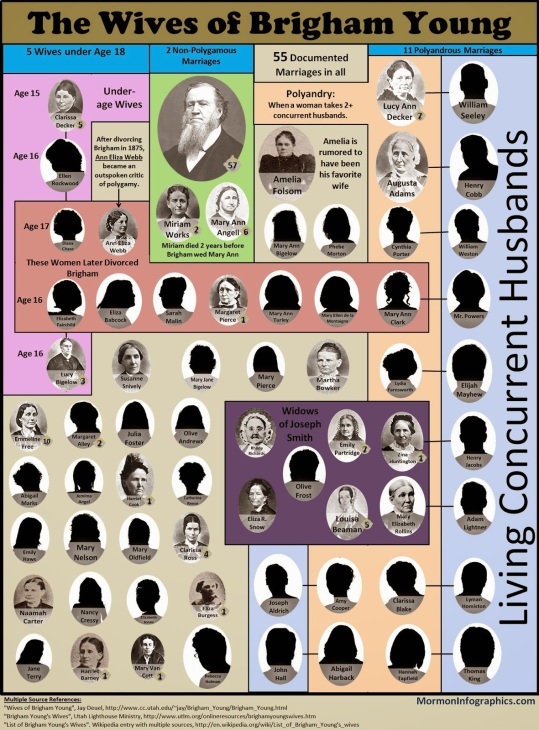
Let’s take Brigham Young for example, He was said to have approximately 55 wives. A loving husband and father would surely spend an equal amount of time loving and caring for each wife and her children. Unfortunately, for Brigham Young’s wives that would mean that Brigham would help change diapers and play catch, less than one week a year. Many of his wives lived together in dorm-like settings. This would mean they may have seen the president of the church more often than one week a year, but the quality time a monogamous relationship is more likely to achieve, was not possible. These incredibly strong women were forced to be basically single parents, loyal to absentee husbands, in a place they  called Zion. Many of them relied on each other to help raise their children so adequately  supplied to them.  Happiness and love was an afterthought. Zina Huntington, one of Brigham’s and Joseph Smith’s wives depressingly stated:
“It is the duty of the first wife to regard her husband not with a selfish devotion… she must regard her husband with indifference, and with no other feeling than that of reverence, for love we regard as a false sentiment; a feeling which should have no existence in polygamy… we believe in the good old custom by which marriages should be arranged by the parents of the young people.”  -New York World, November 17, 1869, as cited in The Lion of the Lord, pp. 229-230
Brigham Young seemed to ignore the lack of love and care with these words:
My wife, though a most excellent woman, has not seen a happy day since I took my second wife;’ ‘No, not a happy day for a year,’ says one; and another has not seen a happy day for five years. It is said that women are tied down and abused: that they are misused and have not the liberty they ought to have; that many of them are wading through a perfect flood of tears, …And my wives have got to do one of two things; either round up their shoulders to endure the afflictions of this world, and live their religion, or they may leave, for I will not have them about me. I will go into heaven alone, rather than have scratching and fighting around me. I will set all at liberty. ‘What, first wife too?’ Yes, I will liberate you all.”I know what my women will say; they will say, ‘You can have as many women as you please, Brigham.’ But I want to go somewhere and do something toget rid of the whiners; I do not want them to receive a part of the truth and spurn the rest out of doors.”-Journal of Discourses, Vol. 4, 1856, pp. 55-57
This comment was an ultimatum given to the women of Utah with a choice that they shape up, or leave and face damnation. Of course, many women did not leave with the threat of eternal damnation over their head. Nevertheless, there was something disturbing to these women that caused grumblings and commotion in the church. It wasn’t just the wives of Brigham Young that suffered. I feel disheartened for the wives of Heber C. Kimball, who struggled for his financial and loving support, when he said:
“I have noticed that a man who has but one wife, and is inclined to that doctrine, soon begins to wither and dry up, while a man who goes into plurality looks fresh, young, and sprightly. Why is this? Because God loves that man, and because he honors his word. Some of you may not believe this, but I not only believe it but I also know it. For a man of God to be confined to one woman is small business… I do not know what we should do if we had only one wife apiece.”-Deseret News, April 22, 1857
Apostle George Q. Cannon further contradicts the proclamation to the family with this statement,
“It is a fact worthy of note that the shortest-lived nations of which we have record have been monogamic. Rome, with her arts, sciences and warlike instincts, was once the mistress of the world; but her glory faded. She was a mono-gamic nation, and the numerous evils attending that system early laid the foundation for that ruin which eventually overtook her.”-Journal of Discourses, v. 13, p. 202
I’m confused, and who wouldn’t be? I understand why the above statements were made. The presidents and apostles defended something that they thought was of God. They were trying desperately to make something work that could not be fixed, they needed it dressed and painted to look presentable to the world. They convinced themselves that polygamy had a purpose and was sensible, yet failed to see that it was a puzzle piece that did not fit in the Kingdom of God.
THE MATH
Let’s discuss the arithmetic of polygamy. Whoever invented polygamy didn’t think the numbers through very well. Polygamy as a long term, multi-generational, possibility, requires an obvious greater number of women. A wise God, knowing polygamy as heavenly form of marriage, did not populate the Earth accordingly. In fact, if anything God did the very opposite of what polygamy requires. It is estimated that for every 100 females born in the world there are 107 males born.  There is already a shortage of girls in the world and polygamy compounds the problem. D&C 131 makes the case for man’s eternal happiness and exaltation even more dire in the face of the doctrine of plural marriage.
D&C 131
In the celestial glory there are three heavens or degrees;
2 And in order to obtain the highest, a man must enter into this order of the priesthood [meaning the new and everlasting covenant of marriage];
And if he does not, he cannot obtain it.
He may enter into the other, but that is the end of his kingdom; he cannot have an increase.
Most Latter-day Saints consider marriage a blessing, an essential step in progression toward perfection, and most importantly a covenant with God to enter his presence. Let me emphasize that it is a REQUIREMENT. Unfortunately, not only will 7 men be left out of marriage possibilities per 50 couples, which is troubling, but polygamy makes marriage an even more daunting endeavor. If every “righteous” man was to take an extra wife, that would reduce marriage possibilities by half. Now instead of 7 men left as bachelors, we have a staggering 57 men unable to find a spouse. That would be 57 men unable to enter the kingdom of God, even if they desperately desired to do so.
If polygamy is the choice form of marriage than there will be some obvious demographic problems with heaven. If every man had three wives, that would mean heaven would be composed of 25% men and 75% women. That seems like some drastic gender inequality. On the one hand, women are forced to share a man because of the sheer lack of them, and on the other hand, it is just as appalling to realize that a loving God would save so many more woman than men. What is it about a man’s gender that predisposes so many less of them to be saved?
If we take it a step further and follow the example of Brigham Young, then heaven looks like a miserably anemic place for men. Brigham Young married 55 women, which if allowed as a possibility in heaven, would mean that 98% of the heavenly populace would be women and only a 2% minority of men. That surely doesn’t sound like heaven for women. Finding an exalted man would be as hard as finding a natural redhead in Spain, you just might want to bring your camera, when you die, to photograph that rare species.  If, on the other hand, the demographics of heaven were more aligned with mortal demographics, instead of multiply wives, it would seem that women would need to take multiple husbands.  It feels just a little more painful when the tables are turned, doesn’t it?
D&C 132STRANGER THAN FICTION
That being said, let’s dive into D&C 132, the scripture that was said to be revelation concerning the plurality of wives. This is the same revelation that justified the practice from Joseph Smith to President Joseph F. Smith. It is the principle that led indirectly to Joseph Smith’s arrest and death, when he ordered the burning of the Nauvoo Expositor, which published his secret practice of plural marriage. It is this revelation that has continued the justification of polygamy among Mormon splinter groups, to this day. It is this revelation that has spread ideas of eternal plural marriage in the next life and the possible return of the principle in this life.  But what does this chapter actually say?  So, in proper LDS fashion, please pull out your scriptures and turn to D&C 132
Verily, thus saith the Lord unto you my servant Joseph, that inasmuch as you have inquired of my hand to know and understand wherein I, the Lord, justified my servants Abraham, Isaac, and Jacob, as also Moses, David and Solomon, my servants, as touching the principle and doctrine of their having many wives and concubines—
ABRAHAM
Abraham is first mentioned as a practitioner of polygamy, which is no secret. It is common knowledge that the practice of multiple wives was not only acceptable in nomadic cultures, but was also a means of status, and a culturally acceptable way to build a tribe. We should not confuse the cultural acceptability of a practice as a sign of God’s tacit approval.  The Lord, in the Old Testament, makes no mention of giving any wife to Abraham.  It is presented as an idea of Sarah.  As she was unable to produce any children for Abraham, she decided that the culturally acceptable practice of polygamy might be a good solution.  It could even be said that a lack of faith, by Sarah and Abraham led to that tumultuous polygamous relationship. The Lord had promised Abraham offspring, yet Sarah could not bear any children. We know, from the story, that Sarah did actually bear a child, Isaac. But instead of waiting for the Lord to deliver on his promise, she toldAbraham, “I pray thee, go in unto my maid; it may be that I may obtain children.” There was no God involved. In fact, this relationship between Hagar and Sarah would breed discontent and jealousy and eventually lead to the expulsion of a child and woman into the desert, away from their family. Does that seem like a gift from God?
ISAAC
Isaac did not have multiple wives, He was married to Rebekah.
JACOB
Jacob also practiced polygamy, but once again there is no mention of a command from the Lord. He was tricked into marrying Leah, and Jacob realized that Laban, her father, was the mastermind of the deceit. Jacob was so intent on marrying Rachel that he continued working for Laban, in order to finally marry the woman of his dreams. Zilpah and Bilhah  were handmaidens of Jacob’s other two wives, none of which were God commanded relationships.  In fact, the scriptures are pretty clear that Zilpah and Bilhah were used by Leah and Rachel in a twisted game of one-upping each other.
MOSES
Moses is just pure speculation, Moses married Zipporah and she is not referenced very much afterward. Moses later marries an Ethiopian woman. There is no reference of plural wives or having two wives at one time.
DAVID AND SOLOMON
It is no secret that David and Solomon had many wives, if you could call them that. Many were concubines, lesser-wives, or as Webster’s 1828 dictionary refers to them “an inferior kind”.  Let’s be honest, when there are hundreds of wives to one man, they are not wives in the modern sense, they are property. And I can confidently proclaim that there are no concubines, or “property wives” in the eyes of a loving God. There are only women. Their inherent value does not change by their title or by the way they are treated. Jacob, of the Book of Mormon, makes it clear that David and Solomon were not acting under the direction of God. Jacob 2 states:
23 But the word of God burdens me because of your grosser crimes. For behold, thus saith the Lord: This people begin to wax in iniquity; they understand not the scriptures, for they seek to excuse themselves in committing whoredoms, because of the things which were written concerning David, and Solomon his son.
24 Behold, David and Solomon truly had many wives and concubines, which thing was abominable before me, saith the Lord.
25 Wherefore, thus saith the Lord, I have led this people forth out of the land of Jerusalem, by the power of mine arm, that I might raise up unto me a righteous branch from the fruit of the loins of Joseph.
26 Wherefore, I the Lord God will not suffer that this people shall do like unto them of old.
THE DOCTRINE AND PRINICPLE
It is important to realize that in verse 1, the revelation states that it is a doctrine and a principle to have plural wives. Many people reason away D&C 132 because they believe that polygamy was a practice and separate from a doctrine. Verse 1 says otherwise. Let’s go on-
Therefore, prepare thy heart to receive and obey the instructions which I am about to give unto you; for all those who have this law revealed unto them must obey the same.
The Lord is saying that if you KNOW the law, you MUST OBEY the law. This should mean that the Church of Jesus Christ of Latter-day Saints is not following the command of the Lord. or are we?…Monogamy is commanded by the Lord in every other scripture. Is God bipolar? I thought our God was the same today, yesterday, and forever.
For behold, I reveal unto you a new and an everlasting covenant; and if ye abide not that covenant, then are ye damnedfor no one can reject this covenant and be permitted to enter into my glory.
Again the Lord is saying you must practice the new and everlasting covenant or you can’t enter his presence. Reiterating the importance of the covenant. This, once again, makes it very difficult for men to enter the kingdom of God if all the women are already married.
Behold, mine house is a house of order, saith the Lord God, and not a house of confusion.
What has caused more confusion in the church than polygamy? What has called into question the character of Joseph Smith more than his secret practice of taking plural wives? Why have we ignored this topic for so long and concealed the fact that Joseph was a polygamist? It may be because it’s confusing and not from the Lord.
15 Therefore, if a man marry him a wife in the world, and he marry her not by me nor by my word, and he covenant with her so long as he is in the world and she with him, their covenant and marriage are not of force when they are dead, and when they are out of the world; therefore, they are not bound by any law when they are out of the world.
16 Therefore, when they are out of the world they neither marry nor are given in marriagebut are appointed angels in heaven, which angels are ministering servants, to minister for those who are worthy of a far more, and an exceeding, and an eternal weight of glory.
17 For these angels did not abide my law; therefore, they cannot be enlarged, but remain separately and singly, without exaltation, in their saved condition, to all eternity; and from henceforth are not gods, but are angels of God forever and ever.
Did you catch that, The God of D&C 132 is saying that Mormon marriages will pave the way for us to become gods, while all of our single members will become our servants. This God puts so much weight on becoming married in the new and everlasting covenant, that any other unions will be dissolved. Those loving and righteous people will live as single angels, doing our bidding for eternity. This sounds great for my wife and me, but I can’t help feeling concerned for my non-temple married friends and the single adults in the ward. D&C 132 even lays it out clearly,  marriages do not happen in the here-after. Which means that God is a respecter of persons. This God seems more interested in saving and exalting married temple goers, than Mother Teresa, Gandhi, and other people, who have done far-more good than I ever will, but were never married in the new and everlasting covenant.  It means that God is a respecter of a woman’s ability to get married more than her innate worth as a person.  This verse seems to place the entire value of a person on their ability to snag a spouse.  Does that sound like the God you worship?
19 … if a man marry a wife by my word, which is my law, and by the new and everlasting covenant…Ye shall come forth in the first resurrection… and shall inherit thrones, kingdoms, principalities, and powers, dominions…and if ye abide in my covenant, and commit no murder whereby to shed innocent blood, it shall be done unto them in all things whatsoever my servant hath put upon them, in time, and through all eternity; and shall be of full force when they are out of the world; and they shall pass by the angels, and the gods, which are set there, to their exaltation and glory in all things, as hath been sealed upon their heads, which glory shall be a fulness and a continuation of the seeds forever and ever.
26 Verily, verily, I say unto you, if a man marry a wife according to my word, and they are sealed by the Holy Spirit of promise, according to mine appointment, and he or she shall commit any sin or transgression of the new and everlasting covenant whatever, and all manner of blasphemies, and if they commit no murder wherein they shed innocent blood, yet they shall come forth in the first resurrectionand enter into their exaltation; but they shall be destroyed in the flesh, and shall be delivered unto the buffetings of Satan unto the day of redemption, saith the Lord God.
I find it most interesting that God said that the only thing that would prevent a covenant married man from entering heaven would be murder.  What about abuse, extortion, adultery, torture, child abandonment, or racist hatred?  Wouldn’t those prevent others from possibly entering the kingdom of God. I am definitely not the judge of anyone’s salvation, but it seems clear to me that a loving God would not make such a claim, that anything short of murder is permissible, as long as you enter the new and everlasting covenant of marriage. So is God a respecter of married persons?  As long as you have made the right covenants, you can do whatever you want and “God will beat us with a few stripes, and at last we shall be saved in the kingdom of God” (2 Nephi 28:7-8)  Does that sound reasonable?
36 Abraham was commanded to offer his son Isaac; nevertheless, it was written: Thou shalt not kill. Abraham, however, did not refuse, and it was accounted unto him for righteousness.
This would be a fair comparison if Isaac was really offered as a sacrifice, but in the most widely used story of the Abrahamic/Isaac sacrifice, Abraham did not actually kill Isaac. In other words, polygamy was not really a test, more like an ultimatum. The early saints actually followed through with the “test” of polygamy and practiced it for nearly 80 years. There was no killing of Isaac involved.  Neither should forced polygamy have been involved.
37 Abraham received concubines, and they bore him children; and it was accounted unto him for righteousness…
38 David also received many wives and concubines, as also many others of my servants, from the beginning of creation until this time; and in nothing did they sin save in those things which they received not of me.
39 David’s wives and concubines were givenunto him of me…
40 I am the Lord thy God, and I gave unto thee, my servant Joseph, an appointment, and restore all things.
Do women have a choice? “received” and “giving”?  Are women given as prizes to the most obedient males? Granted, I believe God works with our cultural practices, but  polygamy was no longer considered a cultural norm at the time of Joseph Smith.  If anything was a revelation from God it was the suffrage movement of the 20th century that turned women from property into people. If there is anything that is evidence of a restoration, it is the final realization of women’s rights. A truer restoration is that of a women’s God given equality and independent mind and personhood, which existed long before Abraham and King David. We needed a restoration of the importance of women.
It seems curious that very little from Old Testament times was “restored” in this “restoration of all things”. Why wasn’t blood sacrifice restored? Why wasn’t the old dietary laws of no pork or shellfish restored? Why weren’t Levite males the sole possessors of the priesthood like in the times of old?  Luckily, Joseph wasn’t commanded to circumcise himself, like they were of old.   None of that was restored, yet the primitive practice of polygamy made a triumphant return.
54 And I command mine handmaid, Emma Smith, to abide and cleave unto my servant Joseph, and to none else. But if she will not abide this commandment she shall bedestroyed, saith the Lord; for I am the Lord thy God, and will destroy her if she abide not in my law.
What happened to the agency for Emma? The Lord respects the agency of mankind SO much that humans are allowed to commit murders, run prostitution rings, embezzle millions of dollars, torture, and molest, without instant judgment reigned down upon their heads.  The Lord, in His mercy, seems to allow them time to change and repent.  Yet Emma Smith must practice polygamy or the Lord will DESTROY her? This sounds much different from the Lord of D&C 3 who stated to Joseph,
10 But remember, God is merciful; therefore, repent of that which thou hast done which is contrary to the commandment which I gave you, and thou art still chosen, and art again called to the work;
11 Except thou do this, thou shalt be delivered up and become as other men, and have no more gift.
The Lord is merciful and He tells Joseph Smith, the prophet of the restoration, the man that the translation of the Book of Mormon hinges upon, the one who communed with the Father, that if he does not repent and translate…he’ll become ordinary. Yep,  ordinary.  Most likely cut off from the Spirit. The same way that all of us are when we sin.  It seems that God is much more willing to be merciful to Joseph than he is to Emma.  Joseph’s transgressions will lead to being ordinary;  Emma, on the other hand will be destroyed.  Does God love Joseph more than he loves Emma?  He seems to be willing to give Joseph multiple opportunities for learning and growth;  Emma not so much. It is interesting to note that Mormon splinter groups, that continue to practice polygamy, use this scripture to scare women into continuing to practice polygamy.  These women are taught that they too will be destroyed if they don’t practice polygamy.  Let’s continue with D&C 132
61 And again, as pertaining to the law of the priesthood—if any man espouse a virgin, and desire to espouse another, and the first give her consent, and if he espouse the second, and they are virgins, and have vowed to no other man, then is he justified; he cannot commit adultery for they are given unto him; for he cannot commit adultery with that that belongeth unto him and to no one else.
This is one of the most damming of verses for the earlier practitioners  of  plural marriage.  Joseph Smith, Brigham Young, and many others, by definition, committed adultery. Both  presidents of the church married women who were already married and several women who were not virgins. Joseph Smith even lied, or as the church officially stated, he used “carefully worded denials”  about the fact that he had many wives to the public and to Emma Smith. This does not help the case for the revelation or the obedience of church leaders to the commandments of God.
joseph_smith_inside
TheWivesOfBrighamYoung
63 But if one or either of the ten virgins, after she is espoused, shall be with another man, she has committed adulteryand shall be destroyed; for they are given unto him to multiply and replenish the earth, according to my commandment, and to fulfil the promise which was given by my Father before the foundation of the world, and for their exaltation in the eternal worlds, that they may bear the souls of men; for herein is the work of my Father continued, that he may be glorified.
In this verse we learn that if a women commits adultery she will be destroyed. No such warning exists in this chapter for men committing adultery.  Yet, if we apply this scripture to men, then the earlier leaders of the church should have had reason to fear for the destruction mentioned in the above scriptures.  But previously we learned that as long as a person married in the new and everlasting covenant doesn’t murder someone they will be exalted.  So….definitely don’t kill someone, but maybe adultery is okay?  I’m not sure.  I’m really confused now.  Also, why is this God so obsessed with virgins?  We should also reject the idea that women are “given” to men to multiply and replenish the Earth. Is this a commandment to multiply and replenish?  Yes!  But D&C 132 completely ignores any other womanly attributes. Women are not just wombs, but equal partners that I would hope a loving God would recognize for more than just their virginity or wombs.  Tithing is also a commandment, we don’t teach men that all they can hope to be is a tithe payer.  We don’t have lesson after lesson on the value of men being their ability to pay tithing to God.  I, likewise, don’t believe that God views women primarily in their virginity and ability or lack of ability to bear children.
  66 And now, as pertaining to this law, verily, verily, I say unto you, I will reveal more unto you, hereafter; therefore, let this suffice for the present. Behold, I am Alpha and Omega. Amen.
I don’t profess to be a scholar or a scriptorian. But, what eventually was revealed was the abandonment of the practice under pressure from The United States. I will not judge the character of Joseph Smith or his contemporaries,  that is job only for God. What I sought to do here was show that we should look at our scripture and the words of the leaders of the church with honesty. And when I look honestly at D&C 132 and the fruits of such words, I do not see God, but the works of men. How about you?