Monday, March 9, 2015

"I will not seek to compel any man to believe as I do, only by the force of reasoning, for truth will cut its own way.”

"The Lord Himself does not attempt coercion in His desire and effort to give peace and salvation to His children. He gives the principles of life and true progress, but leaves every person free to choose or to reject His teachings. This plan the Authorities of the Church try to follow.  
The Prophet Joseph Smith once said: “I want liberty of thinking and believing as I please.” This liberty he and his successors in the leadership of the Church have granted to every other member thereof… 
Again, as recorded in the History of the Church (Volume 5, page 498 [499] Joseph Smith said further: “If I esteem mankind to be in error, shall I bear them down? No. I will lift them up, and in their own way too, if I cannot persuade them my way is better; and I will not seek to compel any man to believe as I do, only by the force of reasoning, for truth will cut its own way.” 
...In the advocacy of this principle leaders of the Church not only join congregations in singing but quote frequently the following: 
“Know this, that every soul is free
To choose his life and what he’ll be,
For this eternal truth is given
That God will force no man to heaven.”
And yet today, in 2015, I'm afraid that masterful message still has not permeated our church the way it needs to--filtered through to all layperson and leader entrusted to administer the church. There continue to be pockets of LDS "leaders" who still think it their duty to compel and coerce the Latter-day Saints into believing one way or another.

This week a Mormon man in Missouri was threatened with excommunication unless he takes down his blog post. In my eyes his blog post holds up a magnifying glass to a revelation I myself have expressed serious concerns with after having actually tried to read it objectively. As Joseph Smith said: "Truth will cut its own way," and Kirk Van Allen's post was a confirmation of the truth about my concerns--and then some. In short, it's a thorough and well-written close up look at Section 132--the revelation on plural marriage. I wish I had written it myself, since my conscience tells me to embrace all truth not just convenient truth, and in my view Kirk exposes the truth.

Even if Kirk's logic was faulty and his ideas completely based in ignorance, President David O. McKay insisted that a man in this Church had a right to believe as he pleased. Thus, even if I hated Kirk's post and totally disagreed with it, the ultimatum to remove it under disciplinary threat flies in the face of the 11th Article of Faith, which claims for each individual the privilege of following "the dictates of our own conscience" and believing "how, where, or what they may."

This kind of religious persecution needs to be exposed for what it is: an attack on the "timeless argument which connects the dignity of human life with respect for individuals and their right to think and act from an informed, reflective, and even prayerful conscience." I say these things and publish my thoughts because, along with Stephen L Richards (who ended up serving as a counselor to David O. McKay in the First Presidency) "I fear dictatorial dogmatism, rigidity of procedure and intolerance even more than I fear" the idea that not all scripture in our cannon is equally inspired.

I feel compelled to stand for freedom of conscience. And I stand with the confidence of Hugh B. Brown (another counselor to David O. McKay in the First Presidency), who called each person to "exercise your God-given right to think through every proposition that is submitted to you and to be unafraid to express your opinions, with proper respect for those to whom you talk and proper acknowledgment of your own shortcomings." Calling for the preservation of freedom of the mind "in education and in religion", President Brown said: "We are not so much concerned with whether your thoughts are orthodox or heterodox as we are that you shall have thoughts."

In another masterful address of his own, President Brown expressed: 
We should, of course, respect the opinions of others, but we should also be unafraid to dissent–if we are informed. Thoughts and expressions compete in the marketplace of thought, and in that competition truth emerges triumphant. Only error fears freedom of expression… This free exchange of ideas is not to be deplored as long as men and women remain humble and teachable. Neither fear of consequence or any kind of coercion should ever be used to secure uniformity of thought in the church. People should express their problems and opinions and be unafraid to think without fear of ill consequences. … We must preserve freedom of the mind in the church and resist all efforts to suppress it.”
He reiterated this all again in his "final testimony"--the last chapter of his memoir. I would like to believe that church leaders today understand President Brown's prophetic voice, but in light of "leader routlette" I don't believe it with much confidence. I do believe with confidence that most priesthood leaders read Doctrine and Covenants 121:41-42 and sincerely desire to lead in their calling "by persuasion, by long-suffering, by gentleness and meekness, and by love unfeigned; By kindness, and pure knowledge, which shall greatly enlarge the soul without hypocrisy, and without guile." Yet, because it is "the nature and disposition" of almost all of them to be easily prone to "unrighteous dominion", I also have a healthy respect for the fact that "many are called, but few are chosen."

Cracking down on a faithful member of the church following the dictates of their conscience and blogging about truth as they understand it, even if it makes some uncomfortable, is the very definition of dictatorial dogmatism, rigidity of procedure, intolerance, and unrighteous dominion. The irony is that actually reading the blog with an open mind might lead to learning something new, or at least allow one to better confront "wrong thinking." Even more ironic is the fact that the LDS Church today would excommunicate someone for believing and practicing polygamy, but Kirk is being threatened with excommunication for disbelieving polygamy and speaking against it as an inspired practice. 

In October of last year I published my opinion that plural marriage wasn't inspired by God and even expressed concerns with D&C 132. I wrote: "It's hard for me to believe a loving God threatening that Emma would be 'destroyed' if she didn't accept polygamy. Some Mormons might embrace this Old Testament-like voice of God without a problem. I tend to blame the heavy-handedness on the human filter dictating the revelation--and maybe not getting the language quite right. Hard to 'feel the Spirit' in that section." Kirk's post helps me (and others as far away as New Zealand) understand why that particular section doesn't pass the "fruits of the spirit" test.

I recall Mitt Romney, being interviewed by Mike Wallace on 60 Minutes, voicing his personal opinion on national television: “I can't imagine anything more awful than polygamy”. Would that we could all feel free to likewise publicly speak our minds, even if it's to say that we can't imagine any revelation more awful than D&C 132. Joseph Smith was once said to have expressed the following: "Some revelations are of God: some revelations are of men: and some revelations are of the devil." Regardless of the accuracy of that quote, Kirk and I share the opinion that it feels more of a revelation of man than of God.

Lester E. Bush was ostracized for publishing his landmark article "Mormonism's Negro Doctrine: An Historical Overview." Today we think of him as a hero because he spoke the truth, even when the truth wasn't convenient for the Church. Exposing the history was a huge piece of the puzzle that eventually led to the 1978 revelation on the priesthood. Because the truth he exposed in his article went against the traditional narrative at the time, which turned out to be wrong, he was shunned by LDS ecclesiastical leaders and "Lester and his family withdrew quietly but completely from church activity, the tragic side of 'the long-promised day'.”

I think we all need to apply what Darius Gray once said about facing up to this difficult episode of our history: "The issue isn’t about finding fault but about learning to be better...For those who feel you are defending the Church please know you are not alone. I have defended it for nearly 42 years and have zero interest in causing any harm...However, I do hope that we, as an institution and as individuals, can come to understand that false teachings are still very much with us and that it is required of us to seek truth — and to speak truth."

If we're self-critical and honest about the past and our history, the truth is that the fruits of polygamy have largely been negative. I can’t bring myself to believe that D&C 132 represents God's true voice even if I wanted to--even if social pressure would make it tempting to just go along with it. My conscience can't accept it as coming from a loving God and no "loving" threat of excommunication can change that. Should I be excommunicated for sharing this opinion? The whole question is ridiculous to me and yet it's Kirk's reality right now. I am not out to inspire negativity--I want to inspire truth seeking. I’ll be damned if I sit back idly and fail to apply the lessons of the past whenever group-thinking and towing the line is enforced, regardless of what individual conscience says. Therefore, in solidarity, I republish the original post (with permission) below: 


D&C 132: A revelation of men, not God


 solomons-wives-and-idolatry 

What I’m about to say to you may seem shocking, but please read through it completely to understand where I am coming from.  I have come to the belief that D&C 132 and Joseph’s teaching of polygamy isn’t, wasn’t, and never will be revelation of God, that polygamy is not of God but rather an idea of men. I believe that it is self-evident that a loving God would not be the author of such confusion, obvious inequality, and emotionally/psychological damage.  I believe firmly that if there ever was a practice and verse of scripture that has failed the test of fruits of the spirit, D&C 132 and polygamy would be a sure bet.
Galatians 5 reads:
22 But the fruit of the Spirit is love, joy, peace, longsuffering, gentleness, goodness, faith,
23 Meekness, temperance: against such there is no law.
Yet, apparently in Mormondom there is a law that does not mesh with the fruits of the spirit. That law is plural marriage. It is a subject that causes many peoples’ stomachs to wrench with disgust. It is a topic that is avoided and often disregarded as something that only God understands, yet plural marriage has and continues to affect the lives of every Latter-day Saint. You don’t believe me?
In my own life my parents had taught me that polygamy was the marriage system of heaven. My mother would say, “How else would Heavenly Mother be able to give birth to billions of spirit children, unless she did not have fellow women to help her?” People in my very Mormon community would say things like, “When they bring back polygamy…..” or “If the prophet asked you to practice polygamy, would you do it?”, as if it would be the ultimate faith and devotion to God. My wife has even more disturbing experiences.  She was taught that the more righteous the man, the more wives he would have in the life to come.  This created a harsh dichotomy in her mind.  She wanted to marry a righteous man and yet didn’t want to share her husband in polygamous heaven.  She was told that it was a principle designed to teach women humility and to overcome jealousy.  (Because no man would ever be jealous or upset over having to share his spouse.)  I’m sure Mormon readers, especially women, have stories of your own. The doctrine of plural marriage continues to deeply affecting much of the church culture to this day. From the way we treat women, to the way church business is conducted, to temple practices, plural marriage still colors the filter we look through. If you do not believe me, you need to follow this link to learn more.
The reason I have decided to write this post is to stand up for the women hurting from this painful teaching. I’m doing it for my posterity, so they will know where I stood on the issue. And I’m doing it for every polygamous wife that has ever felt the agony of watching their spouse kiss and love another woman.  I’m doing this for every faithful woman that wrestles with the tortuous thought of a polygamous “heaven”. I’m doing this in an effort to help people realize, that with honest study and prayer, you can come to see that polygamy should be thrown into the dust bin of mistakes, never to be resurrected again, and that those rejecting polygamy still remain faithful to God. Let me show you why I believe what I believe-
MONOGAMY
From personal experience, members of the Church of Jesus Christ of Latter-day Saints have always been of the opinion that a primary purpose of polygamy was to bring forth more children. God requires polygamy to raise up a righteous generation, yet God has shown in scriptures that monogamous couples are preferred for the of start civilizations, dispensations, and righteous generations.
Adam and Eve, the first people.
Genesis 2
 23 And Adam said, This is now bone of my bones, and flesh of my flesh: she shall be called Woman, because she was taken out of Man.
24 Therefore shall a man leave his father and his mother, and shall cleave unto his wife: and they shall be one flesh.
Noah and his wife, our first parents after the flood that destroyed mankind.
Genesis 7
9 There went in two and two unto Noah into the ark, the male and the female, as God had commanded Noah…
13 In the selfsame day entered Noah, and Shem, and Ham, and Japheth, the sons of Noah, and Noah’s wife, and the three wives of his sons with them, into the ark;
Lehi and Sariah, the first parents of the ancient Americas
1 Nephi 1
5…and he did travel in the wilderness with his family, which consisted of my mother, Sariah, and my elder brothers, who were Laman, Lemuel, and Sam.
In each case Adam, Noah, and Lehi all had one wife at a time. When there was dire need to repopulate the Earth with a righteous population, these men found that a loving equal was all that they needed to brave a new world. The scriptures continue to support monogamy in D&C 42:22, 1 Timothy 3:2,12, D&C 49:16, Jacob 2 and 3, Ephesians 5:31 and the list goes on. There are many scriptures that support the overarching idea that a man should cleave unto one woman and none else.
Science, itself, has shown that those in polygamous relationships have less children than monogamous couples would.  For example: if a man had three wives, and each of his wives had three children, there would be 9 children born.  Statistically, three men married to those same women would have an average of 12 children instead of only nine.  If God was looking for quick repopulation, polygamy is not a good way to go about it.
It is self-evident that monogamy is the only type of relationship where total fidelity, trust, and equality can be accomplished. This is something a polygamous relationship cannot provide. In polygamy, marital relationships are perverted beyond something recognizable to any modern Mormon. The Proclamation to the Family, heralded as the blueprint to a successful, godly society states,
All human beings-male and female—are created in the image of God. Each is a beloved spirit son or daughter of heavenly parents, and, as such, each has a divine nature and destiny…Husband and wife have a solemn responsibility to love and carefor each other and for their children…Parents have a sacred duty to rear their children in love and righteousness, to provide for their physical and spiritual needs, and to teach them to love and serve one another…We warn that individuals who violate covenants of chastity, who abuse spouse or offspring, or who fail to fulfill family responsibilities will one day stand accountable before God.
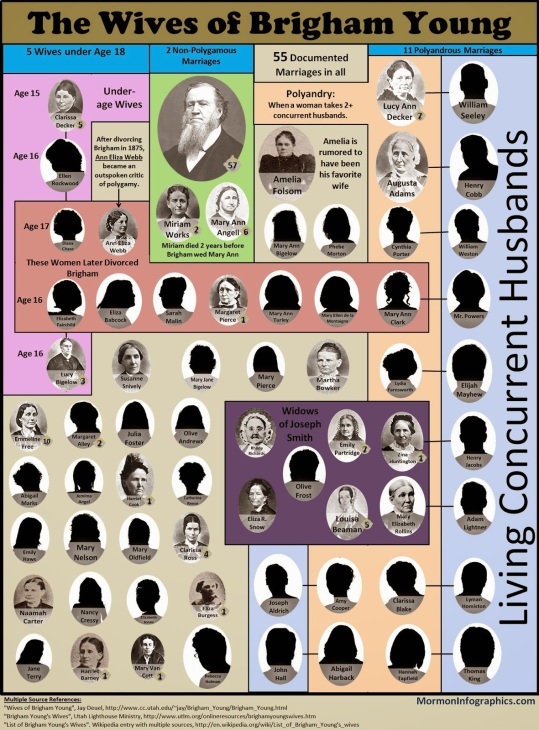
Let’s take Brigham Young for example, He was said to have approximately 55 wives. A loving husband and father would surely spend an equal amount of time loving and caring for each wife and her children. Unfortunately, for Brigham Young’s wives that would mean that Brigham would help change diapers and play catch, less than one week a year. Many of his wives lived together in dorm-like settings. This would mean they may have seen the president of the church more often than one week a year, but the quality time a monogamous relationship is more likely to achieve, was not possible. These incredibly strong women were forced to be basically single parents, loyal to absentee husbands, in a place they  called Zion. Many of them relied on each other to help raise their children so adequately  supplied to them.  Happiness and love was an afterthought. Zina Huntington, one of Brigham’s and Joseph Smith’s wives depressingly stated:
“It is the duty of the first wife to regard her husband not with a selfish devotion… she must regard her husband with indifference, and with no other feeling than that of reverence, for love we regard as a false sentiment; a feeling which should have no existence in polygamy… we believe in the good old custom by which marriages should be arranged by the parents of the young people.”  -New York World, November 17, 1869, as cited in The Lion of the Lord, pp. 229-230
Brigham Young seemed to ignore the lack of love and care with these words:
My wife, though a most excellent woman, has not seen a happy day since I took my second wife;’ ‘No, not a happy day for a year,’ says one; and another has not seen a happy day for five years. It is said that women are tied down and abused: that they are misused and have not the liberty they ought to have; that many of them are wading through a perfect flood of tears, …And my wives have got to do one of two things; either round up their shoulders to endure the afflictions of this world, and live their religion, or they may leave, for I will not have them about me. I will go into heaven alone, rather than have scratching and fighting around me. I will set all at liberty. ‘What, first wife too?’ Yes, I will liberate you all.”I know what my women will say; they will say, ‘You can have as many women as you please, Brigham.’ But I want to go somewhere and do something toget rid of the whiners; I do not want them to receive a part of the truth and spurn the rest out of doors.”-Journal of Discourses, Vol. 4, 1856, pp. 55-57
This comment was an ultimatum given to the women of Utah with a choice that they shape up, or leave and face damnation. Of course, many women did not leave with the threat of eternal damnation over their head. Nevertheless, there was something disturbing to these women that caused grumblings and commotion in the church. It wasn’t just the wives of Brigham Young that suffered. I feel disheartened for the wives of Heber C. Kimball, who struggled for his financial and loving support, when he said:
“I have noticed that a man who has but one wife, and is inclined to that doctrine, soon begins to wither and dry up, while a man who goes into plurality looks fresh, young, and sprightly. Why is this? Because God loves that man, and because he honors his word. Some of you may not believe this, but I not only believe it but I also know it. For a man of God to be confined to one woman is small business… I do not know what we should do if we had only one wife apiece.”-Deseret News, April 22, 1857
Apostle George Q. Cannon further contradicts the proclamation to the family with this statement,
“It is a fact worthy of note that the shortest-lived nations of which we have record have been monogamic. Rome, with her arts, sciences and warlike instincts, was once the mistress of the world; but her glory faded. She was a mono-gamic nation, and the numerous evils attending that system early laid the foundation for that ruin which eventually overtook her.”-Journal of Discourses, v. 13, p. 202
I’m confused, and who wouldn’t be? I understand why the above statements were made. The presidents and apostles defended something that they thought was of God. They were trying desperately to make something work that could not be fixed, they needed it dressed and painted to look presentable to the world. They convinced themselves that polygamy had a purpose and was sensible, yet failed to see that it was a puzzle piece that did not fit in the Kingdom of God.
THE MATH
Let’s discuss the arithmetic of polygamy. Whoever invented polygamy didn’t think the numbers through very well. Polygamy as a long term, multi-generational, possibility, requires an obvious greater number of women. A wise God, knowing polygamy as heavenly form of marriage, did not populate the Earth accordingly. In fact, if anything God did the very opposite of what polygamy requires. It is estimated that for every 100 females born in the world there are 107 males born.  There is already a shortage of girls in the world and polygamy compounds the problem. D&C 131 makes the case for man’s eternal happiness and exaltation even more dire in the face of the doctrine of plural marriage.
D&C 131
1 In the celestial glory there are three heavens or degrees;
2 And in order to obtain the highest, a man must enter into this order of the priesthood [meaning the new and everlasting covenant of marriage];
3 And if he does not, he cannot obtain it.
4 He may enter into the other, but that is the end of his kingdom; he cannot have an increase.
Most Latter-day Saints consider marriage a blessing, an essential step in progression toward perfection, and most importantly a covenant with God to enter his presence. Let me emphasize that it is a REQUIREMENT. Unfortunately, not only will 7 men be left out of marriage possibilities per 50 couples, which is troubling, but polygamy makes marriage an even more daunting endeavor. If every “righteous” man was to take an extra wife, that would reduce marriage possibilities by half. Now instead of 7 men left as bachelors, we have a staggering 57 men unable to find a spouse. That would be 57 men unable to enter the kingdom of God, even if they desperately desired to do so.
If polygamy is the choice form of marriage than there will be some obvious demographic problems with heaven. If every man had three wives, that would mean heaven would be composed of 25% men and 75% women. That seems like some drastic gender inequality. On the one hand, women are forced to share a man because of the sheer lack of them, and on the other hand, it is just as appalling to realize that a loving God would save so many more woman than men. What is it about a man’s gender that predisposes so many less of them to be saved?
If we take it a step further and follow the example of Brigham Young, then heaven looks like a miserably anemic place for men. Brigham Young married 55 women, which if allowed as a possibility in heaven, would mean that 98% of the heavenly populace would be women and only a 2% minority of men. That surely doesn’t sound like heaven for women. Finding an exalted man would be as hard as finding a natural redhead in Spain, you just might want to bring your camera, when you die, to photograph that rare species.  If, on the other hand, the demographics of heaven were more aligned with mortal demographics, instead of multiply wives, it would seem that women would need to take multiple husbands.  It feels just a little more painful when the tables are turned, doesn’t it?
D&C 132, STRANGER THAN FICTION
That being said, let’s dive into D&C 132, the scripture that was said to be revelation concerning the plurality of wives. This is the same revelation that justified the practice from Joseph Smith to President Joseph F. Smith. It is the principle that led indirectly to Joseph Smith’s arrest and death, when he ordered the burning of the Nauvoo Expositor, which published his secret practice of plural marriage. It is this revelation that has continued the justification of polygamy among Mormon splinter groups, to this day. It is this revelation that has spread ideas of eternal plural marriage in the next life and the possible return of the principle in this life.  But what does this chapter actually say?  So, in proper LDS fashion, please pull out your scriptures and turn to D&C 132
1 Verily, thus saith the Lord unto you my servant Joseph, that inasmuch as you have inquired of my hand to know and understand wherein I, the Lord, justified my servants Abraham, Isaac, and Jacob, as also Moses, David and Solomon, my servants, as touching the principle and doctrine of their having many wives and concubines—
ABRAHAM
Abraham is first mentioned as a practitioner of polygamy, which is no secret. It is common knowledge that the practice of multiple wives was not only acceptable in nomadic cultures, but was also a means of status, and a culturally acceptable way to build a tribe. We should not confuse the cultural acceptability of a practice as a sign of God’s tacit approval.  The Lord, in the Old Testament, makes no mention of giving any wife to Abraham.  It is presented as an idea of Sarah.  As she was unable to produce any children for Abraham, she decided that the culturally acceptable practice of polygamy might be a good solution.  It could even be said that a lack of faith, by Sarah and Abraham led to that tumultuous polygamous relationship. The Lord had promised Abraham offspring, yet Sarah could not bear any children. We know, from the story, that Sarah did actually bear a child, Isaac. But instead of waiting for the Lord to deliver on his promise, she toldAbraham, “I pray thee, go in unto my maid; it may be that I may obtain children.” There was no God involved. In fact, this relationship between Hagar and Sarah would breed discontent and jealousy and eventually lead to the expulsion of a child and woman into the desert, away from their family. Does that seem like a gift from God?
ISAAC
Isaac did not have multiple wives, He was married to Rebekah.
JACOB
Jacob also practiced polygamy, but once again there is no mention of a command from the Lord. He was tricked into marrying Leah, and Jacob realized that Laban, her father, was the mastermind of the deceit. Jacob was so intent on marrying Rachel that he continued working for Laban, in order to finally marry the woman of his dreams. Zilpah and Bilhah  were handmaidens of Jacob’s other two wives, none of which were God commanded relationships.  In fact, the scriptures are pretty clear that Zilpah and Bilhah were used by Leah and Rachel in a twisted game of one-upping each other.
MOSES
Moses is just pure speculation, Moses married Zipporah and she is not referenced very much afterward. Moses later marries an Ethiopian woman. There is no reference of plural wives or having two wives at one time.
DAVID AND SOLOMON
It is no secret that David and Solomon had many wives, if you could call them that. Many were concubines, lesser-wives, or as Webster’s 1828 dictionary refers to them “an inferior kind”.  Let’s be honest, when there are hundreds of wives to one man, they are not wives in the modern sense, they are property. And I can confidently proclaim that there are no concubines, or “property wives” in the eyes of a loving God. There are only women. Their inherent value does not change by their title or by the way they are treated. Jacob, of the Book of Mormon, makes it clear that David and Solomon were not acting under the direction of God. Jacob 2 states:
23 But the word of God burdens me because of your grosser crimes. For behold, thus saith the Lord: This people begin to wax in iniquity; they understand not the scriptures, for they seek to excuse themselves in committing whoredoms, because of the things which were written concerning David, and Solomon his son.
24 Behold, David and Solomon truly had many wives and concubines, which thing was abominable before me, saith the Lord.
25 Wherefore, thus saith the Lord, I have led this people forth out of the land of Jerusalem, by the power of mine arm, that I might raise up unto me a righteous branch from the fruit of the loins of Joseph.
26 Wherefore, I the Lord God will not suffer that this people shall do like unto them of old.
THE DOCTRINE AND PRINICPLE
It is important to realize that in verse 1, the revelation states that it is a doctrine and a principle to have plural wives. Many people reason away D&C 132 because they believe that polygamy was a practice and separate from a doctrine. Verse 1 says otherwise. Let’s go on-
3 Therefore, prepare thy heart to receive and obey the instructions which I am about to give unto you; for all those who have this law revealed unto them must obey the same.
The Lord is saying that if you KNOW the law, you MUST OBEY the law. This should mean that the Church of Jesus Christ of Latter-day Saints is not following the command of the Lord. or are we?…Monogamy is commanded by the Lord in every other scripture. Is God bipolar? I thought our God was the same today, yesterday, and forever.
4 For behold, I reveal unto you a new and an everlasting covenant; and if ye abide not that covenant, then are ye damned; for no one can reject this covenant and be permitted to enter into my glory.
Again the Lord is saying you must practice the new and everlasting covenant or you can’t enter his presence. Reiterating the importance of the covenant. This, once again, makes it very difficult for men to enter the kingdom of God if all the women are already married.
8 Behold, mine house is a house of order, saith the Lord God, and not a house of confusion.
What has caused more confusion in the church than polygamy? What has called into question the character of Joseph Smith more than his secret practice of taking plural wives? Why have we ignored this topic for so long and concealed the fact that Joseph was a polygamist? It may be because it’s confusing and not from the Lord.
15 Therefore, if a man marry him a wife in the world, and he marry her not by me nor by my word, and he covenant with her so long as he is in the world and she with him, their covenant and marriage are not of force when they are dead, and when they are out of the world; therefore, they are not bound by any law when they are out of the world.
16 Therefore, when they are out of the world they neither marry nor are given in marriage; but are appointed angels in heaven, which angels are ministering servants, to minister for those who are worthy of a far more, and an exceeding, and an eternal weight of glory.
17 For these angels did not abide my law; therefore, they cannot be enlarged, but remain separately and singly, without exaltation, in their saved condition, to all eternity; and from henceforth are not gods, but are angels of God forever and ever.
Did you catch that, The God of D&C 132 is saying that Mormon marriages will pave the way for us to become gods, while all of our single members will become our servants. This God puts so much weight on becoming married in the new and everlasting covenant, that any other unions will be dissolved. Those loving and righteous people will live as single angels, doing our bidding for eternity. This sounds great for my wife and me, but I can’t help feeling concerned for my non-temple married friends and the single adults in the ward. D&C 132 even lays it out clearly,  marriages do not happen in the here-after. Which means that God is a respecter of persons. This God seems more interested in saving and exalting married temple goers, than Mother Teresa, Gandhi, and other people, who have done far-more good than I ever will, but were never married in the new and everlasting covenant.  It means that God is a respecter of a woman’s ability to get married more than her innate worth as a person.  This verse seems to place the entire value of a person on their ability to snag a spouse.  Does that sound like the God you worship?
19 … if a man marry a wife by my word, which is my law, and by the new and everlasting covenant…Ye shall come forth in the first resurrection… and shall inherit thrones, kingdoms, principalities, and powers, dominions…and if ye abide in my covenant, and commit no murder whereby to shed innocent blood, it shall be done unto them in all things whatsoever my servant hath put upon them, in time, and through all eternity; and shall be of full force when they are out of the world; and they shall pass by the angels, and the gods, which are set there, to their exaltation and glory in all things, as hath been sealed upon their heads, which glory shall be a fulness and a continuation of the seeds forever and ever.
26 Verily, verily, I say unto you, if a man marry a wife according to my word, and they are sealed by the Holy Spirit of promise, according to mine appointment, and he or she shall commit any sin or transgression of the new and everlasting covenant whatever, and all manner of blasphemies, and if they commit no murder wherein they shed innocent blood, yet they shall come forth in the first resurrection, and enter into their exaltation; but they shall be destroyed in the flesh, and shall be delivered unto the buffetings of Satan unto the day of redemption, saith the Lord God.
I find it most interesting that God said that the only thing that would prevent a covenant married man from entering heaven would be murder.  What about abuse, extortion, adultery, torture, child abandonment, or racist hatred?  Wouldn’t those prevent others from possibly entering the kingdom of God. I am definitely not the judge of anyone’s salvation, but it seems clear to me that a loving God would not make such a claim, that anything short of murder is permissible, as long as you enter the new and everlasting covenant of marriage. So is God a respecter of married persons?  As long as you have made the right covenants, you can do whatever you want and “God will beat us with a few stripes, and at last we shall be saved in the kingdom of God” (2 Nephi 28:7-8)  Does that sound reasonable?
36 Abraham was commanded to offer his son Isaac; nevertheless, it was written: Thou shalt not kill. Abraham, however, did not refuse, and it was accounted unto him for righteousness.
This would be a fair comparison if Isaac was really offered as a sacrifice, but in the most widely used story of the Abrahamic/Isaac sacrifice, Abraham did not actually kill Isaac. In other words, polygamy was not really a test, more like an ultimatum. The early saints actually followed through with the “test” of polygamy and practiced it for nearly 80 years. There was no killing of Isaac involved.  Neither should forced polygamy have been involved.
37 Abraham received concubines, and they bore him children; and it was accounted unto him for righteousness…
38 David also received many wives and concubines, as also many others of my servants, from the beginning of creation until this time; and in nothing did they sin save in those things which they received not of me.
39 David’s wives and concubines were givenunto him of me…
40 I am the Lord thy God, and I gave unto thee, my servant Joseph, an appointment, and restore all things.
Do women have a choice? “received” and “giving”?  Are women given as prizes to the most obedient males? Granted, I believe God works with our cultural practices, but  polygamy was no longer considered a cultural norm at the time of Joseph Smith.  If anything was a revelation from God it was the suffrage movement of the 20th century that turned women from property into people. If there is anything that is evidence of a restoration, it is the final realization of women’s rights. A truer restoration is that of a women’s God given equality and independent mind and personhood, which existed long before Abraham and King David. We needed a restoration of the importance of women.
It seems curious that very little from Old Testament times was “restored” in this “restoration of all things”. Why wasn’t blood sacrifice restored? Why wasn’t the old dietary laws of no pork or shellfish restored? Why weren’t Levite males the sole possessors of the priesthood like in the times of old?  Luckily, Joseph wasn’t commanded to circumcise himself, like they were of old.   None of that was restored, yet the primitive practice of polygamy made a triumphant return.
54 And I command mine handmaid, Emma Smith, to abide and cleave unto my servant Joseph, and to none else. But if she will not abide this commandment she shall bedestroyed, saith the Lord; for I am the Lord thy God, and will destroy her if she abide not in my law.
What happened to the agency for Emma? The Lord respects the agency of mankind SO much that humans are allowed to commit murders, run prostitution rings, embezzle millions of dollars, torture, and molest, without instant judgment reigned down upon their heads.  The Lord, in His mercy, seems to allow them time to change and repent.  Yet Emma Smith must practice polygamy or the Lord will DESTROY her? This sounds much different from the Lord of D&C 3 who stated to Joseph,
10 But remember, God is merciful; therefore, repent of that which thou hast done which is contrary to the commandment which I gave you, and thou art still chosen, and art again called to the work;
11 Except thou do this, thou shalt be delivered up and become as other men, and have no more gift.
The Lord is merciful and He tells Joseph Smith, the prophet of the restoration, the man that the translation of the Book of Mormon hinges upon, the one who communed with the Father, that if he does not repent and translate…he’ll become ordinary. Yep,  ordinary.  Most likely cut off from the Spirit. The same way that all of us are when we sin.  It seems that God is much more willing to be merciful to Joseph than he is to Emma.  Joseph’s transgressions will lead to being ordinary;  Emma, on the other hand will be destroyed.  Does God love Joseph more than he loves Emma?  He seems to be willing to give Joseph multiple opportunities for learning and growth;  Emma not so much. It is interesting to note that Mormon splinter groups, that continue to practice polygamy, use this scripture to scare women into continuing to practice polygamy.  These women are taught that they too will be destroyed if they don’t practice polygamy.  Let’s continue with D&C 132
61 And again, as pertaining to the law of the priesthood—if any man espouse a virgin, and desire to espouse another, and the first give her consent, and if he espouse the second, and they are virgins, and have vowed to no other man, then is he justified; he cannot commit adultery for they are given unto him; for he cannot commit adultery with that that belongeth unto him and to no one else.
This is one of the most damming of verses for the earlier practitioners  of  plural marriage.  Joseph Smith, Brigham Young, and many others, by definition, committed adultery. Both  presidents of the church married women who were already married and several women who were not virgins. Joseph Smith even lied, or as the church officially stated, he used “carefully worded denials”  about the fact that he had many wives to the public and to Emma Smith. This does not help the case for the revelation or the obedience of church leaders to the commandments of God.
joseph_smith_inside
TheWivesOfBrighamYoung
63 But if one or either of the ten virgins, after she is espoused, shall be with another man, she has committed adultery, and shall be destroyed; for they are given unto him to multiply and replenish the earth, according to my commandment, and to fulfil the promise which was given by my Father before the foundation of the world, and for their exaltation in the eternal worlds, that they may bear the souls of men; for herein is the work of my Father continued, that he may be glorified.
In this verse we learn that if a women commits adultery she will be destroyed. No such warning exists in this chapter for men committing adultery.  Yet, if we apply this scripture to men, then the earlier leaders of the church should have had reason to fear for the destruction mentioned in the above scriptures.  But previously we learned that as long as a person married in the new and everlasting covenant doesn’t murder someone they will be exalted.  So….definitely don’t kill someone, but maybe adultery is okay?  I’m not sure.  I’m really confused now.  Also, why is this God so obsessed with virgins?  We should also reject the idea that women are “given” to men to multiply and replenish the Earth. Is this a commandment to multiply and replenish?  Yes!  But D&C 132 completely ignores any other womanly attributes. Women are not just wombs, but equal partners that I would hope a loving God would recognize for more than just their virginity or wombs.  Tithing is also a commandment, we don’t teach men that all they can hope to be is a tithe payer.  We don’t have lesson after lesson on the value of men being their ability to pay tithing to God.  I, likewise, don’t believe that God views women primarily in their virginity and ability or lack of ability to bear children.
  66 And now, as pertaining to this law, verily, verily, I say unto you, I will reveal more unto you, hereafter; therefore, let this suffice for the present. Behold, I am Alpha and Omega. Amen.
I don’t profess to be a scholar or a scriptorian. But, what eventually was revealed was the abandonment of the practice under pressure from The United States. I will not judge the character of Joseph Smith or his contemporaries,  that is job only for God. What I sought to do here was show that we should look at our scripture and the words of the leaders of the church with honesty. And when I look honestly at D&C 132 and the fruits of such words, I do not see God, but the works of men. How about you?

Tuesday, March 3, 2015

Mormonism: A Sausage Makers Religion

A friend of mine, Christian Harrison--whom some bloggers may know as "Silus Grok"--first introduced me to the metaphor of the sausage maker in relation to Mormonism. Chew on this:
Do we prescribe bed rest and further enfeeble the weak minded? Or do we prescribe exercise and enjoin our siblings in faith to embrace a dynamic faith? Mormonism isn't an easy faith. It's the sausage maker's religion...Mormonism requires us to be active in making our own faith: an open canon, personal revelation, messy recent history, hard truths, prolific talks from leaders only a small number of which qualify as prophetic…you name it. We've signed up for a faith that is CONSTANTLY — RELIGIOUSLY, even — reinventing itself. And, like sausage making, it's not always a pretty picture. You have to get your hands dirty. And sometimes someone looses a finger. Mormonism, then, is a sausage makers' faith.
I was reminded of those astute words last week while reading Bryndis Robert's guest post at Flunking Sainthood. She's an attorney, an adult convert to the LDS Church from the Black Baptist faith, and she currently serves as a Relief Society President in Atlanta, Georgia. I find her voice perceptive and insightful. Below I only quote a portion of her words, but I endorse the entire post: 
I love sausage. However, I don’t like the sausage-making process. Through hands-on experience, I know that it’s ugly and messy. My family had a small farm where we raised chickens and hogs. Each fall, our rural community would get together for hog-killing day. Each person had a job. My job was to make the sausage. First, I had to choose which parts of the hog to use. Then, I had to wash the meat several times, chop it into chunks, and grind it (making sure not to lose any fingers in the process). Next, I had to mix and season the meat. I then had to stuff it into casings and form links or shape it into patties. So, what did I learn from that experience?
  • Making sausage requires time and manual dexterity. 
  • Not paying attention could cause me to injure myself. 
  • I had lots of choices of ingredients when making sausage. 
  • My choices determined the quality and taste of the sausage I made. 
The intersection of politics, social justice, and religion reminds me of making sausage. It’s an ugly and scary place to be. There’s the possibility of injury to the heart, mind, and soul. We have choices to make.  
As a member of the LDS Church, it has been difficult to watch the Church I love deal with this intersection—particularly on the issue of marriage equality and other rights for the LGBTQIA community. When the missionaries were teaching me, I was honest about my political and social views and the fact that I fall squarely in the Liberal or Progressive box. I was concerned about conflict between my political and social views and those of the Church. My missionaries pointed to the 12th Article of Faith and assured me that:
  • members of the Church covered the entire political spectrum; 
  • the Church encouraged members, as individuals, to be involved in the political process; and 
  • the Church, as an organization, did not interfere in the political process.
Bryndis goes on to say:
I don’t know all of the answers, but there are a few things I do know:
  • Navigating the intersection of politics, social justice, and religion requires a balance of courage, conviction, compassion, and compromise. 
  • I cannot rely on anyone, including any Church leader, to choose my beliefs. I must choose. 
  • I have to use my divinely given gifts of reasoning and intelligence to discern the correct course for me. 
  • My choices will determine the kind of person that I am.
I share these convictions and I confess that being a Mormon like this can indeed feel like a "meat grinder" at times. It's not always pleasant, but I still love meat. Despite the "eat meat sparingly" rhetoric of the Word of Wisdom, I'm admittedly a Mormon meat lover--both literally and metaphorically.

Sometimes when I start talking about or craving the metaphorical meat people respond as though I should be content with milk. I understand milk for an infant, but children of God are meant to grow up into adults of God. Therefore, I find it a little insulting (and thus resent) when I'm treated like an infant and also by how often it feels like I'm being force-fed milk after having become an adult.

I hope to always retain the best of the Christ-endorsed child-like qualities, but this doesn't mean I continue to have a child-like relationship with the Church. Like Paul, I've grown up and "put away childish things" (1 Corinthians 13:11.) I've matured in my faith and as I've done so I've also come to have a more mature understanding of scripture. As Terryl Givens put it, "Scripture is a human manifestation of an impulse toward and from the divine. One can't expect textual flawlessness."

It can be a bit frightening to realize that all of God's most objective truths are always evaluated subjectively. It's initially jarring to realize that there is no such thing as unmediated revelation--that it always comes through a human filter. So while I continue to choose faith and to trust God, I no longer equate "LDS priesthood authorities" with God. I trust mortal leaders to do their best to seek inspiration, but I'm not trusting them to give us unfiltered or unmediated revelation. Everything that comes to us comes through our human experience, our human language, and human culture. And we "see through a glass darkly".

Once upon a time I took comfort in believing there was an infallible standard I could rely on. Similar to how Armand Mauss shifted his faith paradigms as he came to understand the social construct of reality, my paradigm now places emphasis on choice--choosing to believe--relying on my own conscience as the final authority for how to live my life. Terryl Givens has explained it this way:

“We want a standard that is infallible because it relieves us of the burden of continually exerting ourselves to use discernment. The way that Dostoyevsky put it so beautifully is that 'We want some person to be a keeper of our conscience'. The hard lesson is that there is never a moment when you can delegate your own volition to another individual.”

Unfortunately I continue to meet many self-proclaimed "orthodox" Saints who take issue with this approach because in their paradigm it lowers the importance of apostles and prophets. By pointing out the need to use individual discernment and rely on our own conscience (our individual best effort to understand the will of God) some have even implied that I'm "attacking" the apostles and prophets, regardless of whether or not they're even "acting as such."

When I refuse to put church leaders up on a pedestal, no one needs to pin evil motives on me or assume I think the apostles are "evil" or "sinister"(words I've seen used.) That would just be crazy talk. I've never in my life even implied such a thing as this. My theory is that this crazy talk is born out of a misunderstanding of what it really means to "sustain" our leaders--but thankfully Christian Harrison has more insight to share on that important topic as well.  In reality the only really crazy thing I can see is how many Mormons want to be "relieved of the burden of individual discernment."

I can understand why people could be initially uncomfortable with individual discernment--the process can involve doubt and uncertainty, and doubt and uncertainty make a lot of people nervous. There are some folks who get nervous when they realize they have to think for themselves and follow their conscience rather than just "follow the leader." I think these folks have yet to learn the "the hard lesson", as Terryl Givens said, that there is never a moment when you can delegate your own volition to another individual leader. This is why Bryndis' words resonate as though they were my personal manifesto:
  • I cannot rely on anyone, including any Church leader, to choose my beliefs. I must choose. 
  • I have to use my divinely given gifts of reasoning and intelligence to discern the correct course for me. 
  • My choices will determine the kind of person that I am.
The sausage making process can make people uncomfortable. It can be messy. But we must embrace the messiness if we're to be faithful to reality. We belong to a sausage makers religion. Can we please stop pretending that things are always clean and tidy as though we're still infants who can't handle the meat? Let's just get comfortable with the idea that we're not always going to be comfortable in a world of ambiguity and uncertainty and get on with the good news of embracing faith and grace.

Friday, February 6, 2015

Dear Elder Christofferson

Dear Elder Christofferson, you recently stated:

“We hope our members will be part of the conversation going forward and let their voices be heard in civil and respectful communications with legislators and others. With more and more people of good will involved, we believe the right balance can be struck.”

I hope I can achieve the right balance here in letting my voice be heard, even if I'm not directly addressing "legislators." By way of introduction, I could very likely be accurately described as a progressive member of the Church--a Liahona Mormon, if you will. But more importantly than that, I want to live so that I could accurately be described as a disciple of Christ. Whatever the forum, hopefully mine is a voice that will "be heard in civil and respectful communications," since regardless of how successful I am in actual implementation, it is my hearts sincere desire to be civil and respectful.

It's not always easy to strike "the right balance" when people have such different expectations of what the right balance is, especially as I find myself in the minority among church members who happen to share a desire for civil marriage equality in the United States. Of course it's no surprise there's a diversity and pluralism even within the church, and I'm going to take your word that you want to allow members of good will--both sides--to be civilly involved and free to voice their conscience. As you expressed in your recent Trib Talk interview: 
We have members in the Church with a variety of different opinions and beliefs and positions on these issues…but…in our view it doesn’t become a problem unless someone is out attacking the church and its leaders, trying to get others to follow them, to draw others away, trying to pull people out of the church, or away from its teachings and doctrines. That’s very different for us, than someone who feels one way or another on a political stance or a particular action to support a group, Affirmation, or any others [such as Ordain Women or Mormons Building Bridges] that you named.
If I ever say something that sounds disrespectful, I will apologize and recommit to striking the right tone to maintain "the right balance." I don't want to be perceived as "attacking" someone just for disagreeing with them. I fear that some members of the church assume that it's inherently disrespectful of me to voice a disagreeing opinion, but my love is greater than my fear, so I proceed. I have no desire to be critical, though I wish to critique a few things I just read today. Even so, I desire to sustain and love you in all the ways I can, even if I cannot always agree on every issue.

President Hugh B. Brown once said:
I admire men and women who have developed the questing spirit, who are unafraid of new ideas as stepping stones to progress. We should, of course, respect the opinions of others, but we should also be unafraid to dissent – if we are informed. Thoughts and expressions compete in the marketplace of thought, and in that competition truth emerges triumphant. Only error fears freedom of expression.
Hugh B. Brown is one of my heroes. I too admire those with "the questing spirit, who are unafraid of new ideas" or of respectfully disagreeing with ideas that don't quite resonate with their informed moral compass. Likewise, I also have great admiration for you and your family, specifically your brother Tom and your parents, who quite soon after Tom came out determined "that nothing would be allowed to break the circle of love that binds all of us together as a family" and expressed that "while none of us is perfect as individuals, we can be perfect in our unconditional love for each other." In my mind the Christoffersons are an incandescent example of putting family first before dogma, their loving example every bit worthy of being included in the Family Acceptance Project.

In that spirit of love, I express my commitment and desire to give you the benefit of the doubt. Regardless of any mistakes, I grant you "extra leeway," as Professor Faulconer put it recently in his blog post "Living With Fallibility": "I give people I love and respect more room for mistakes than I do others. My children can do a lot more than can strangers before I lose faith in them. People whom I have had good experiences with previously also get extra leeway. And if I sincerely believe that a person has been called by God, I am willing to continue to trust them though I am aware of their failings."

I'm not sure how accurately the words I read today reflect your heart, but they did cause me some concern. If I must respectfully dissent than I do so with the confidence that ultimately the truth will prevail. As President Hal Eyring's father Henry once said: "In this Church you have only to believe the truth. Find out what the truth is." I take that responsibility as seriously as if I were a pioneer, for "where truth flies you follow If you are a pioneer."

Anytime I hear someone express with great certainty that they "know" something to be "true" (regardless of whether it can or can't be proven to be true), I take the liberty of reassuring myself that what they really mean is that they strongly believe it to be true. For even objective truth is always evaluated subjectively. Mormons have historically, of course, expressed with great certainty things they "know" to be "true". In recent years I've become much more comfortable with ambiguity and uncertainty. I walk by faith, not certainty.

Many well-meaning Mormon leaders of the past have spoken with great certainty, even authoritatively, but had to recant their words once they received further light and knowledge. Forgiveness is a form of grace I willingly offer our fallible leaders. Yet along with my willingness to forgive, I cannot forget that my church leaders are not infallible. Because of my understanding of history and because of my faith, even anxious expectation for ongoing revelation and greater light and knowledge, I never want to put a period where perhaps God has intended a comma.  I still expect many great and important things to be revealed and/or clarified because our understanding of doctrinal teachings is constantly evolving. Of all religious people, Mormons should never say "never."

According to the Church News report you recently said that we should all be sensitive as "we humbly seek greater understanding," and I definitely agree with that. However, you then seemed to express certainty about an area I hope we can still humbly achieve greater understanding and in which I still see room for greater light and knowledge. I specifically have in mind how our LGBT brothers and sisters have in the past, currently, and in the future, aligned/align with the law of chastity.

As you acknowledged, there are voices saying that the current standards of chastity and morality as taught in the Church are wrong and should not apply in their lives. Mine has not been one of those voices, but I don't judge someone for thinking that, since historically the LDS Church has been wrong about some teachings (for example, Race and the Priesthood). Furthermore, some very important standards have changed as we went from accepting monogamy to reluctantly embracing polygamy, then to toting polygamy as a requirement for the celestial kingdom and even calling monogamy evil and a curse, then reluctantly going back to monogamy and eventually even excommunicating people for practicing polygamy, and now embracing monogamy as the Lord's true and unchanging standard.

Keeping our dizzying past in mind, these "voices" should be forgiven for expressing doubt about your quote: “Some even suppose that those standards will someday change. That is simply not true." Likewise, with the past in mind, there may be legitimate doubt with the Church trying to maintain the Lord’s standard. I have faith that the Lord's standard is the way “a fulness of happiness” can be found in this life and throughout eternity, as you said. But because so many standards have changed with the times, I think you can understand why I would express doubt that the Church's standards are always perfectly aligned with and representative of the Lord's standards.

I'm all for the Lord's standards. I don't think the Lord's standard changes. However, I think our collective understanding (and the Church's understanding) of His standards do change. Our collective understanding of and dealing with homosexuality and the gospel have already changed in recent decades, and most definitely for the better. I'm convinced we're closer today to understanding and acting how the Lord would have us think and act in regards to our LGBT brothers and sisters. My stake president agrees with this last point too. I emailed him a link to a genuinely impressive article published just two days ago in BYU's "Universe" and my stake president (who is a loving and wonderful friend and the kind of leader of whom you would be very proud), replied back: "That was a great article. We really are coming along and living closer to what The Savior wants us to be."

While I agree with my stake president that we're getting closer, I'm not convinced we've arrived quite to where the Lord would have us be. Moreover, I'm sensitive, as I'm sure you are, to all the times we Latter-day Saints have fallen short in our treatment of our LGBT members and neighbors. I feel genuinely sorry for any pain we have caused. I'm also aware of active LDS gay members reactions to the press conference you recently held with the media and respect their voice too.

I've recently been reading "This Is My Doctrine": The Development of Mormon Theology. Perhaps because of this I'm extra sensitive to hearing people say that "doctrine never changes" or "will never change", because in reality practically all of our doctrines (even the nature of God) have evolved and changed over time, even since the beginning of the Restoration. Because I assume you're also aware of this, I'll grant that you may be using a different definition of "doctrine," which is not uncommon in my experience. But I think we both agree that the Lord's standards don't change. The only thing that changes is our understanding of His will, His standards, His doctrine.

Of course those not of our faith--the majority of human beings both gay and straight (or those anywhere in-between on the Kinsey scale)--have no reason to trust the LDS Church to tell them what "the Lord's standard" is. I think most Americans are perfectly willing to allow religious freedom as long as that freedom is not used to infringe on the rights or freedom of other citizens, or used as a cloak for discrimination. Naturally we all have different opinions and positions, even among traditional and non-traditional Christians (Mormons included.) As I'm sure you are well aware, many LDS apostles have even held a variety of views and interpretations on matters of revelation and scripture, holding beliefs in opposition to fellow apostles. "In essentials let there be unity; in non-essentials, liberty, and in all things, charity." Granted, informed members of our faith can even sometimes disagree on what constitutes the essentials too. C'est la vie in a church absent infallibility.

Therefore, while I trust the Church of Jesus Christ to seek Christ and be a community of support to those of us in the church, I do not trust the Church to be a reservoir of infallible truth. Again, all truth, even objective truth, is evaluated subjectively. As Dr. Phil Barlow has put it, "the church is made up entirely of human beings" striving in faith to seek the divine. Because we're all fallible humans who make up the church, "faith is misconstrued when we think of the church as essentially divine marred only by a few freckles or difficulties, but rather is better conceived of as made up entirely of human beings (with everything that implies, and it implies a great deal)…from top to bottom and from Joseph Smith on, who are trying to respond to the divine with which they've been touched in faith."

I believe Saints who trust Salt Lake to give them all the right answers or God's direction for their individual lives are putting their trust in the wrong source. I certainly don't give those leading the church that much control or power over my life. As I've written before, "I now recognize that I am in the drivers seat of my own search for the divine--not the Church™. I can be myself and embrace all the truths I find in the world, right where I am--while Mormon. If the culture were to ever make me feel like I couldn't do this, or embrace what apostle and former member of the First Presidency Hugh B Brown called "An Eternal Quest--Freedom of the Mind", or tolerate me as a free thinker, than I would no longer find that culture worth belonging to."

As a free-thinking Mormon I may not always feel comfortable at church, but I never question whether I belong. Now some conservative conformists may question whether I belong in the church, but this is not their church any more than it is my church. And if ultimately it's the Savior's church, I'd prefer that He be the one to judge if I belong in the church rather than a fallible bishop or stake president who may or may not share my thoughts or feelings or understand where I'm coming from and who may very well use his position to coerce me or threaten my removal from the body of Christ.

This possibility has been on my mind lately, especially as "excommunication looms over Mormons grappling with some of [the] church's tenets." I understand you've expressed great confidence in bishops and stake presidents who attempt to judge worthiness and qualification to participate in the ordinances and sacraments of the Church. We do indeed have many great bishops and stake presidents. But I confess, for me it's hard to think them capable of judging matters of eternal importance when I believe only God is capable of being the perfect judge. Some mortal judges are much better equipped than others. Therefore, Elder Christofferson, I'm not sure I place the same degree of confidence in authorities as you seem to. I've witnessed too much ecclesiastical roulette to have unshaken confidence in ecclesiastical leaders. I regret to say that I don't even have an equal degree of confidence in your fellow quorum members. In fact, I worry the church community as a whole may be placing too much power and confidence in authority.

I only look to God's perfection to expect perfection. But even then, my understanding is perhaps best articulated by the late BYU historian, Richard Poll:
James Madison cautioned: "When the Almighty Himself condescends to address mankind in their own language, His meaning, luminous as it must be, is rendered dim and doubtful by the cloudy medium through which it is communicated." Because I believe, with Madison, that everyone, including Paul and the other prophets, saw eternity, or sees eternity through a glass darkly, prophetic infallibility, scriptural inerrancy, and unquestioning obedience are not elements in my faith.
I don't personally ever expect to have to face church discipline, because my heart's in the right place, and to my knowledge I haven't said or done anything wrong. If I have, I'd be happy to be corrected. Yet the possibility, under the current system, exists. So even if I were the one conducting any formal or informal discipline, I would do so with great uneasiness and want to error on the side of charity and tolerance and inclusivity. Speaking of errors, the Church News reported that you added "if there are significant errors that may occur in the judgment process—and they will be rare—there is an opportunity for appeal to correct any such mistakes."

My question for you is how you can be so confident that these "errors" would be "rare?" My reading of Doctrine and Covenants 121:39 suggests to me that it would be more rare that errors not often occur, since, "we have learned by sad experience that it is the nature and disposition of almost all men, as soon as they get a little authority, as they suppose, they will immediately begin to exercise unrighteous dominion."

I fully believe most priesthood leaders read Doctrine and Covenants 121:41-42 and sincerely desire to lead in their calling "by persuasion, by long-suffering, by gentleness and meekness, and by love unfeigned; By kindness, and pure knowledge, which shall greatly enlarge the soul without hypocrisy, and without guile." Yet, because it is "the nature and disposition" of almost all of them to be easily prone to "unrighteous dominion", I also have a healthy respect for the fact that "many are called, but few are chosen."

When friends for whom I feel love and respect are expunged from the body of Christ by well-intended but fallible ecclesiastical leaders, and the decisions of those ecclesiastical leaders are generally trusted, upheld, and appeals denied because church leaders want to express confidence and trust in local leadership, then essentially you're granting local leaders a degree of infallibility just without saying the word. Of course I can't speak with much confidence about the appeals process because it is so secretive, and also because I've never personally had anything to appeal, but nothing in the current system gives me much confidence that the institution of the Church wouldn't hesitate to sacrifice one to save the ninety and nine. 

But I digress. Back to the point of expressing with confidence that our doctrine, particularly our understanding of the law of chastity, will "never change," I only wish you might read and consider what conservative law professor and LDS blogger Nathan Oman wrote several years ago:
Ultimately, I think that gay marriage is a good idea. I think that recognizing gay marriage has the potential to create stronger gay families and a better environment to grow up in for the children of homosexuals. It also carries within itself the possibility for an ethic of gay chastity, which ultimately strikes me as superior to either gay celibacy or gay promiscuity. I understand that in its fullest religious sense, gay chastity for Latter-day Saints (as opposed to gay celibacy) requires revelation to those with greater religious authority than I, and I am comfortable sustaining that authority. Nevertheless, in my all-things-considered independent judgment, gay chastity is a good idea.
I too think an ethic of gay chastity is a good idea. It would be good for the church to draw a distinction between two good and committed Saints who, according to their sexual orientation--which they cannot change--desire to be legally and lawfully married, as compared to others who live promiscuously without any divinely led commitment of being faithful to their companion. "The Doctrine of Celibacy" is another matter. The "Doctrine of Chastity" would remain in place and indeed, the law of chastity would never go away, but I could foresee our understanding of it evolving and changing if we're open to receiving greater light and knowledge.

When I read President Dieter Uchtdorf's wise words I personally include our current understanding of human sexuality: 
Brothers and sisters, as good as our previous experience may be, if we stop asking questions, stop thinking, stop pondering, we can thwart the revelations of the Spirit. Remember, it was the questions young Joseph asked that opened the door for the restoration of all things. We can block the growth and knowledge our Heavenly Father intends for us. How often has the Holy Spirit tried to tell us something we needed to know but couldn’t get past the massive iron gate of what we thought we already knew?
I hope we Mormons never place an iron gate between us and our Heavenly Father. While His constant love for His children is certain not to change, historically speaking, the only constant thing about Mormonism is change, and that's one thing I personally love about Mormonism. May we embrace the lessons of history and have faith in the future, regardless of its uncertainty.

I appreciate that the Church today is calling for “fairness to all”, an end to discrimination where it exists, while at the same time, desiring to protect the liberty of people of conscience “to live fully loyal to their conscience,” as you put it. I agree with this wholeheartedly. Though I sometimes wonder what would have happened to me had I lived before the 1978 Church revelation on the priesthood, especially if my conscience had told me that the temple and priesthood restrictions based on race were wrong. How comfortable would I have been if I were expected to remain silent and passively wait for church leaders to receive revelation? Would it have been appropriate to civilly and respectfully voice my desires for change?

I imagine pre-1978 there were some Latter-day Saints whose conscience led them to feeling embarrassed by the church's dogmatic adherence to what was believed to be "doctrine" from God, constant and unchanging. Yet today the Church recognizes that its pre-1978 policies based on what was once considered doctrine were wrong and "disavows the theories advanced in the past." Forgotten in the collateral damage are good folks like Dr. Lowry Nelson. I'm pained as I read the correspondence between Dr. Nelson and Church Headquarters, especially in light of how history has completely vindicated Brother Nelson.

Today, in this new Civil Rights era for the LGBT community, I'm afraid that my conscience and the position of officials currently leading the church might also be at odds. So I'm in a bit of a precarious position. I wait patiently, though not passively, and encourage progress in areas that I can, while trying to be anxiously engaged in good causes and follow my conscience without causing harm to the church. Sometimes I wonder, though, how long I can continue in good faith and enough patience before feeling embarrassed about my church's current position, similarly to those who felt embarrassed by the church's pre-1978 position. Granted, these are two separate issues entirely, but there are also many similarities. Saying that something will "never change" is a theory that may or may not prove to be correct.

I fully understand that I'm in no position to make any change, but the more I see a need for change the more I want to have hope for it and desire it. Whether it's this issue or the issue of gender equality, I ask questions and hope I have the strength to patiently wait for desired changes. I'm inspired by God's loving and kind example as he waits patiently and lovingly for us to correct our perspectives and figure out His will for ourselves. But I'm also keenly aware of what President Kimball once wrote in a letter to his son Ed: "Revelations will probably never come unless they are desired. I think few people receive revelations while lounging on a couch."

Whether that change comes sooner than expected or never comes at all, either way, I will be at peace knowing I was fully loyal to my conscience.


Wednesday, February 4, 2015

"'A Prophet is not always a Prophet' only when he is acting as such"

Joseph Smith wrote in his diary on February 8th, 1843: “'A Prophet is not always a Prophet' only when he is acting as such."

Today there are plenty of folks who could still learn a thing or two from Brother Joseph. While Latter-day Saints continue to sustain one man as "prophet, seer, and revelator, and president of The Church of Jesus Christ of Latter-day Saints", historically these four roles haven't exactly resembled what they once did whenever Joseph Smith acted "as such."

Leading the modern Church with it's accompanying bureaucracy calls for 24/7 administration ("the office of the President") but the firehose of revelation that came forth in Joseph's day isn't exactly gushing out the "prophet, seer, and revelator" roles these days as much as the "President of the Church" role. We still sustain men who hold the keys to "act as such", but regardless of whether you speak for God or whether you're a chef with the "keys" to a great kitchen, the proof will always be in the pudding.

The modern rhetoric of "follow the prophet" is usually packaged with a period instead of the comma Joseph Smith seemed to be suggesting. We should follow the prophet, whenever the prophet is actually acting as a prophet. But when's the last time you asked yourself when or if the prophet "is acting as such"?

Granted, Joseph Smith didn't elaborate much on how we're to differentiate when exactly a prophet is acting as a prophet, as opposed to say, acting in the role or full-time office of church president. The work of differentiation is left up to each individual, and it's not the kind of responsibility or work we can outsource to others or expect the corporation of the Church or the PRetheren to confirm in a press release. We must each seek the Lord's will, "study it out in [our] mind," prayerfully seek personal revelation, inspiration, and the Spirit. We don't just take someone else's word for it, we go directly to the source and let the Holy Spirit guide us directly to Christ. In essence, it's real work.

Unfortunately a lot of us don't like doing that work for ourselves. We often want it to be easy or trust some middle-man to do it for us. It's tempting to want to go on autopilot and not take the risk of doing the mental and spiritual work for yourself. Otherwise well-intended disciples of Christ become instead disciples of the prophet who "follow the prophet" with great conviction but not much differentiation of if or when a prophet is acting as such. Is it possible that some Latter-day Saints thus put too much weight on their faith and trust in a man ("the arm of the flesh") rather than in Christ?

Before the "new" primary songbook came out in 1989, Duane Hiatt was asked to write a happy song "about Old Testament prophets" that would sound "like a Jewish Folk Song"--fun for the children to sing. He came up with some clever verses, such as this one:

"Jonah was a prophet, tried to run away,
But he later learned to listen and obey.
When we really try, the Lord won't let us fail:
That's what Jonah learned deep down inside the whale
."

Each verse was then followed by the following chorus:

"Follow the prophet, follow the prophet,
Follow the prophet; don't go astray.
Follow the prophet, follow the prophet,
Follow the prophet; he knows the way
."

The song is extremely successful in teaching children one part of the equation--to follow "the prophet," but when do the children learn the next part of the equation? When do we teach them how to discern when or if a prophet is acting as a prophet? My concern is that our church community has largely defaulted on that part of the equation and children then grow into adults at risk of worshiping the idol of infallible leadership.

I understand that children can't be expected to master calculus before they've learned basic arithmetic. But if we truly want to "keep things simple" and avoid teaching the complexities of discerning when a prophet is actually acting as a prophet, I offer my alternative chorus free of charge:

Follow the Savior, follow the Savior, follow the Savior
Don’t go astray
Follow the Savior, follow the savior, follow the Savior,
He is the Way! 


I first came up with that alternative chorus while writing the blog post "Follow the…" in which I first voiced some personal reservations. After all, unless you're reading this "correlated version", the scriptures never actually include the words "follow the prophet." The actual Doctrine of Christ emphasizes "Follow the Son." And thankfully primary children do already have many wonderful and scripturally sound songs about trying to be like Jesus and following in his ways, feeling the Savior's love, and lovingly expressing commitment to "follow [Him] faithfully".

If I belonged to the Church of the Prophets then I wouldn't even be concerned, but because this is the professed Church of Jesus Christ, it would be reasonable to teach primarily more of Christ and loyalty to Him rather than loyalty to following mortal prophets and risk turning children into unthinking lemmings, or into grown adults unable to process Joseph Smith's teaching that a prophet is not always a prophet--only when acting as such.

At some point in time children of God must become adults of God and the training wheels have to come off. An online friend who recognizes this truth recently wrote some new lyrics for an additional verse to "Follow the Prophet." I highly recommend them: 

"Our inspired prophets sometimes make mistakes
Never blindly follow, caution we must take
It is up to us to know how to discern
In our search for truth we still have much to learn!"

Once upon a time, after reading the 14th chapter of Ezekiel, Joseph Smith "said the Lord had declared by the Prophet [Ezekiel], that the people should each stand for himself, and depend on no man or men in that state of corruption of the Jewish Church – that righteous persons could only deliver their own souls – applied it to the present state of the Church of Jesus Christ of Latter-day Saints – said if the people departed from the Lord, they must fall– that they were depending on the Prophet, hence were darkened in their minds, in consequence of neglecting the duties devolving upon themselves…" (TPJS, pg. 237-238)

Truly, it is up to us to know how to discern, and in our search for truth we all still have much to learn.

Another friend put it this way: "I believe in the divinely-sanctioned role of prophets and I love the brethren, but I see that we are simply repeating the mistakes of the past by failing to believe that we can connect with heaven on our own. NOBODY comes between you and the Lord. That is the beauty of the story of a 14-year-old boy who asked of the Lord in faith and entered into His presence to receive truth for himself."

That really is a beautiful truth. That is good news. Actually, I like best how Adam Miller put it:

This is both the good news and the bad news. While it is scary to think that God works through weak, partial, and limited mortals like us, the only thing scarier would be thinking that he doesn't. It's a false dilemma to claim that either God works through flawless people or God doesn't work at all. The gospel isn't a celebration of God's power to work with flawless people. The gospel is a celebration of God's willingness to work today, in our world, in our lives, with people who clearly aren't. To demand that church leaders, past or present, show us only a mask of angelic pseudo-perfection is to deny the gospel's most basic claim: that God's grace works through our weakness. We need prophets, not idols. Our prophets and leaders will not turn out to be who you want them to be. They are not, in fact, even what God might want them to be. But they are real and God really can, nonetheless, work through their imperfections to extend his perfect love.

Friday, January 23, 2015

"How in the world in the 21st century is a church asking people not to talk openly about things?"

I struggle to always express things gracefully and diplomatically; regardless, along with Thomas Jefferson "I have sworn upon the altar of god eternal hostility against every form of tyranny over the mind of man." So this quote from John Dehlin on the Salt Lake Tribune's "Trib Talk" really resonated with me:

"How in the world in the 21st century is a church asking people not to talk openly about things? And I want to be really clear about something. People say that I'm talking openly about my doubts and disbelief and giving voice to doubters because I'm trying to tear people away from the church. That is so wrong. I'm a mental health professional. I'm a few months away from getting my PhD in clinical and counseling psychology. I counsel Mormons everyday. And what I can tell you is that, by far, probably one of the most damaging aspects of Mormon culture is the fact that they need to keep things hidden, they keep things secret, and they can't openly discuss what they think and what they feel. I think this leads to depression, I think it leads to anxiety, I think it leads ostracization and marginalization, and I think it can even lead to suicide and things more serious. And so it is totally unacceptable for a church leader to say to me "you can support same-sex marriage but you can't speak openly about your support", "you can support Ordain Women but don't ever tell anybody", "you can have doubts, but you can't speak openly about those doubts." I think that's a recipe for mental illness and sadness, and frankly, it doesn't engender a community that's meaningful where people are able to share their heart and their soul with each other. It's not going to be a backbone for the church culturally that's going to lead to vibrance and vitality when an organization like the church starts to use sort of Stalinist techniques or Maoist techniques to clamp down on information, to prevent people from talking, to punish people if they speak openly. That leads to the death of community, to conscience, to people's mental health and well-being, and I would much rather be disciplined than violate my conscience."

29:05--30:31 minute mark
http://youtu.be/x5vCVNv4moY


*Also relevant is the story of Sterling McMurrin and David O. McKay: See "Heretical Beliefs and Feeling Welcome in the Church"